Risk Management · 2025
In this section2 topics
Risk Management Policy & Plan
Policy & Plan Description
QTC Energy Public Company Limited places strong emphasis on enterprise risk management as a key component of good corporate governance and as a core mechanism supporting the achievement of strategic objectives, financial stability, and long-term sustainable growth, amid a volatile and rapidly changing business environment.
The Company has clearly established its enterprise risk management policy and framework in accordance with the international ERM–COSO standards to ensure that risk identification, assessment, and management are conducted in a systematic, transparent, and strategy-aligned manner. Oversight of risk management is the responsibility of the Risk Management and Sustainability Committee, which is tasked with setting direction, monitoring, and evaluating the effectiveness of risk management practices, and regularly reporting to the Board of Directors.
Under the enterprise risk management policy, significant risks affecting the Company’s business operations encompass strategic risks, financial risks, operational risks, legal and regulatory compliance risks, as well as business continuity risks. In addition, the Company places importance on environmental, social, and governance (ESG) risks, including climate change, occupational health and safety, information technology and cybersecurity, as well as risks related to business partners and the supply chain.
The Company’s enterprise risk management process covers the analysis of the business context and operating environment, the establishment of strategic objectives, risk identification and assessment, the formulation of risk response plans and control measures, as well as ongoing monitoring and reporting. This process is designed to ensure that risks are managed effectively and in a timely manner.
The Company’s enterprise risk management is integrated with its sustainability operations and good corporate governance practices in order to mitigate potential impacts on stakeholders, create business opportunities, and enhance competitiveness. This integration is a key factor in generating added value and delivering sustainable long-term returns to shareholders.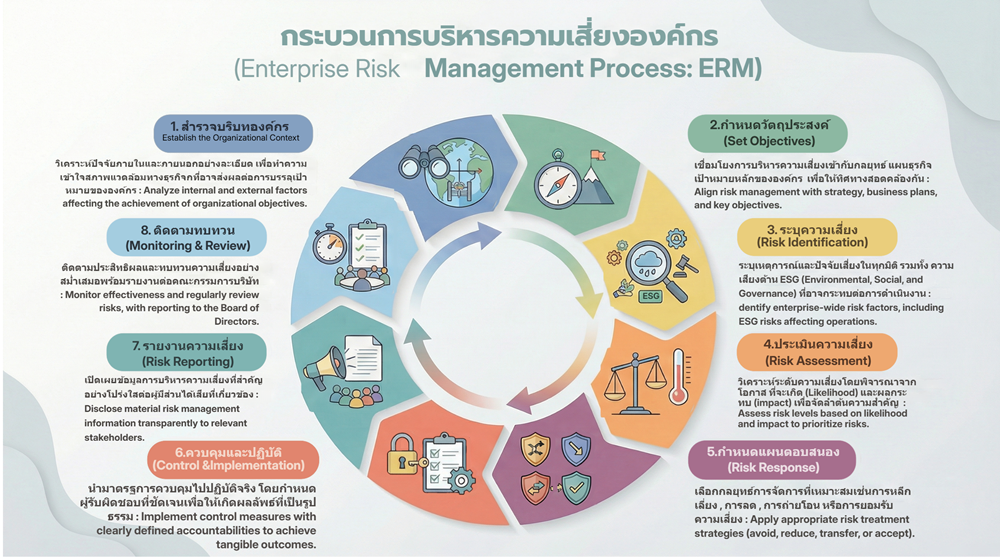
Policy Document Link
https://qtc-energy.com/wp-content/uploads/2026/02/RISK_MANAGEMENT_POLICY_EN.pdf
Risks to the Company's Business Operations
Risk Register
| Risk Name | Risk Characteristics | Consequences | Management Measures | Related Risk Factors |
|---|---|---|---|---|
| Dependence on Major Customers in the Transformer Business | As the majority of revenue in the transformer business is derived from public sector bidding projects, the Company is exposed to risks arising from political uncertainty, which may affect government budget disbursements. In addition, intense market competition, which is beyond the Company’s control, further increases business risk. | Sales performance did not meet expectations. |
Restructured the organizational structure to enhance efficiency and responsiveness to increasingly diverse customer requirements. | 734 · Description: Reliance on large customers or few customers · Info category: STRATEGIC_RISK · 1714 · Description: Competition risk · Info category: STRATEGIC_RISK · 1715 · Description: Economic risk · Info category: STRATEGIC_RISK |
| Climate Change | The impacts of climate change have led to environmental crises, including irregular rainfall patterns, droughts, flooding, rising global temperatures, and adverse effects on ecosystems and livelihoods worldwide. Mitigating these impacts requires cooperation from all sectors across all countries to reduce greenhouse gas emissions through both direct and indirect mechanisms. These include regulatory measures to control greenhouse gas emissions, carbon taxation, carbon-related trade barriers embedded in products, and increasing consumer preferences for low-carbon products. Such developments present both opportunities and risks for the sustainable operation of businesses in the future. | -Potential future expenses related to carbon tax or carbon credits -Possible tradebarriers -Raw material shortages in the production process | Increase the proportion of clean energy consumption
| 756 · Description: Change in laws and regulations · Info category: COMPLIANCE_RISK · 746 · Description: Delays in the development of future projects · Info category: OPERATIONAL_RISK · 750 · Description: Climate change and disasters · Info category: OPERATIONAL_RISK · 751 · Description: Impact on the environment · Info category: OPERATIONAL_RISK · 1719 · Description: Climate change and disasters · Info category: STRATEGIC_RISK |
| Occupational Health and Safety | The health and safety of employees, as well as stakeholders involved in business processes, represent a significant risk that the organization must manage to a standard exceeding legal requirements. Substantial financial resources are required to implement preventive measures, as workplace accidents not only result in employee injuries or illnesses but also lead to various costs that the organization must bear, such as medical expenses, compensation, remediation costs, and property damage, depending on the severity of the incident. If this risk cannot be effectively controlled and results in serious injuries or fatalities, it may damage the organization’s reputation, undermine its credibility, or even affect its ability to continue operating. Furthermore, should such incidents occur within the supply chain and cause disruptions in raw material deliveries, they may also impact the organization’s production processes and product delivery. |
|
| 758 · Description: Violations of laws and regulations · Info category: COMPLIANCE_RISK · 749 · Description: Safety, occupational health, and working environment · Info category: OPERATIONAL_RISK · 1717 · Description: ESG risk · Info category: STRATEGIC_RISK · 753 · Description: Impact on human rights · Info category: OPERATIONAL_RISK |
| Hazardous Waste and Waste Materials from Production Management | Laws and regulations related to waste management in industrial facilities are continuously revised and updated to enhance the standards of responsibility for waste generators, waste transporters, and waste disposal operators. At the same time, public and community awareness and concern regarding environmental impacts have significantly increased. Social media enables rapid information dissemination, which is often accompanied by unclear or inaccurate facts. If an organization fails to give due importance to legal compliance or neglects proper supervision and control over waste transportation and disposal practices, it may face reputational risks, suspension of its operating license, or legal penalties in the form of fines. Furthermore, improper waste management may also result in adverse impacts on biodiversity. |
|
| 758 · Description: Violations of laws and regulations · Info category: COMPLIANCE_RISK · 1723 · Description: Legal risk · Info category: COMPLIANCE_RISK · 736 · Description: Damage to company image and reputation · Info category: STRATEGIC_RISK · 1717 · Description: ESG risk · Info category: STRATEGIC_RISK · 751 · Description: Impact on the environment · Info category: OPERATIONAL_RISK |
| Corruption | The company’s transformer manufacturing business operates as an industrial facility, involving manufacturing, repair, sales, and related services. These operations must be conducted in compliance with applicable laws, regulations, and requirements. In addition, the business requires ongoing coordination and interaction with relevant authorities, including the payment of fees and taxes, as well as commercial transactions with government agencies. Such circumstances may create potential gaps or exposure to corruption risks. |
|
| 758 · Description: Violations of laws and regulations · Info category: COMPLIANCE_RISK · 759 · Description: Corporate Governance · Info category: COMPLIANCE_RISK · 1723 · Description: Legal risk · Info category: COMPLIANCE_RISK · 736 · Description: Damage to company image and reputation · Info category: STRATEGIC_RISK · 1717 · Description: ESG risk · Info category: STRATEGIC_RISK · 754 · Description: Corruption · Info category: OPERATIONAL_RISK |
| Investing in Other Businesses | Due to the high number of competitors in the transformer business, both domestically and internationally, and the intense competition, it is necessary to invest in energy-related businesses that are connected to the transformer business to diversify risk. It is essential to thoroughly analyze investment data by specialized experts before making any investments. |
|
| 1724 · Description: Liquidity risk · Info category: FINANCIAL_RISK · 1725 · Description: Income volatility · Info category: FINANCIAL_RISK · 1716 · Description: New business risk · Info category: STRATEGIC_RISK |
| Volatility of Foreign Exchange Rates and Raw Material Prices | Since the production of transformers requires importing key raw materials from abroad, accounting for 60% of the annual raw material value, and exporting transformers accounting for 20-30% of sales, the foreign exchange rates and raw material prices, such as copper and silicon steel, fluctuate according to global economic conditions and significant world events. |
|
| 764 · Description: Fluctuation in exchange rates, interest rates, or the inflation rate · Info category: FINANCIAL_RISK · 1715 · Description: Economic risk · Info category: STRATEGIC_RISK |
| Accounts Receivable Management | Due to current commercial competition, it is necessary to extend credit to customers to gain a competitive advantage. However, if the customers to whom the company has extended credit lack financial discipline and do not adhere to the debt repayment agreements, it results in overdue debts. This causes the company to not receive payments on time, impacting the management of financial liquidity. | Financial Liquidity Management |
| 763 · Description: Default on payment or exchange of goods · Info category: FINANCIAL_RISK · 1724 · Description: Liquidity risk · Info category: FINANCIAL_RISK |
| Employee Turnover Risk of Engineers, Skilled Workers, and Key Personnel | Due to the factory being located in an industrial area with high competition for labor, ranging from manual laborers to professional levels. | Shortage of skilled personnel |
| 738 · Description: Reliance on employees in key positions · Info category: OPERATIONAL_RISK · 739 · Description: Shortage or reliance on skilled workers · Info category: OPERATIONAL_RISK |
| Non-compliance with the law | The business of manufacturing transformers is an industrial factory that produces, repairs, sells, and provides services to government and private sectors both domestically and internationally. Therefore, there are many laws and regulations that the company must comply with. These laws and regulations often change. | May be subject to legal fines, lawsuits, or license suspension, leading to reputational damage. |
| 756 · Description: Change in laws and regulations · Info category: COMPLIANCE_RISK · 758 · Description: Violations of laws and regulations · Info category: COMPLIANCE_RISK · 741 · Description: Systems or internal control system · Info category: OPERATIONAL_RISK · 759 · Description: Corporate Governance · Info category: COMPLIANCE_RISK · 1723 · Description: Legal risk · Info category: COMPLIANCE_RISK · 736 · Description: Damage to company image and reputation · Info category: STRATEGIC_RISK |
| Human Rights and Personal Data Protection | The business nature of QTC Energy includes several subsidiary companies. Business activities encompass manufacturing, trading, and investing in various projects. Each business activity creates a value chain from upstream, midstream, to downstream, involving many stakeholders in this value chain. The company may unknowingly participate in human rights violations within the value chain and cannot claim ignorance. |
|
| 1723 · Description: Legal risk · Info category: COMPLIANCE_RISK · 1717 · Description: ESG risk · Info category: STRATEGIC_RISK · 753 · Description: Impact on human rights · Info category: OPERATIONAL_RISK · 1720 · Description: System disruption risk · Info category: OPERATIONAL_RISK |
| Cyber Security | It is a risk that poses a security threat to business operations, which is likely to occur and cause damage to critical business information. |
|
| 758 · Description: Violations of laws and regulations · Info category: COMPLIANCE_RISK · 732 · Description: Changes in technologies · Info category: STRATEGIC_RISK · 744 · Description: Information security and cyber-attack · Info category: OPERATIONAL_RISK · 753 · Description: Impact on human rights · Info category: OPERATIONAL_RISK · 1720 · Description: System disruption risk · Info category: OPERATIONAL_RISK |
| Dependence on Key Management Personnel in Business Operations | The Company’s management relies significantly on leadership with specialized expertise in transformer manufacturing, and such leadership has become closely associated with the product brand. This reliance is an important factor in building confidence among stakeholders. However, any future changes related to key organizational leaders may potentially affect the confidence of key stakeholders, including shareholders, employees, and customers. |
|
| 738 · Description: Reliance on employees in key positions · Info category: OPERATIONAL_RISK |
| Emergency Situations | This risk arises from potential disasters, such as flooding at the Bangkok headquarters, fires at the headquarters or the Rayong manufacturing plant, or incidents affecting any subsidiaries. |
|
| 750 · Description: Climate change and disasters · Info category: OPERATIONAL_RISK |