

Sustainability · 2025
In this section51 topics
- Sustainability Policy2 items
- Sustainability Goals & UN SDGs3 items
- Policy Review2 items
- Business Value Chain1 item
- Stakeholder Analysis1 item
- Environmental Policy & Guidelines3 items
- Environmental Policy Review3 items
- Energy — Plan & Guidelines2 items
- Energy — Electricity Consumption1 item
- Energy — Fuel Consumption1 item
- Energy — Targets2 items
- Energy — Performance & Outcomes2 items
- Water — Plan & Guidelines2 items
- Water — Withdrawal, Discharge & Consumption1 item
- Water — Targets2 items
- Water — Performance & Outcomes2 items
- Waste — Plan & Guidelines2 items
- Waste — Generation, Disposal & Recycling1 item
- Waste — Targets2 items
- Waste — Performance & Outcomes2 items
- GHG — Plan & Guidelines2 items
- GHG — Emissions1 item
- GHG — Emissions Verification2 items
- GHG — Principles & Standards1 item
- GHG — Targets1 item
- GHG Targets — Net Zero1 item
- GHG Targets — Carbon Neutrality1 item
- GHG Targets — Other Targets1 item
- GHG — Performance & Outcomes2 items
- Environmental Legal Incidents1 item
- Social Policy & Guidelines3 items
- Social Policy Review3 items
- Social — Principles & Standards Practised1 item
- Human Rights Due Diligence2 items
- Employees — Plan & Guidelines3 items
- Employees — Workforce1 item
- Employees — Remuneration & Provident Fund1 item
- Employees — Training & Development1 item
- Employees — Occupational Health & Safety1 item
- Employees — Labour Relations1 item
- Employees — Employee Representation2 items
- Employees — Targets2 items
- Employees — Performance & Outcomes2 items
- Customers — Plan & Guidelines3 items
- Customers — Satisfaction Results1 item
- Customers — Targets2 items
- Customers — Performance & Outcomes2 items
- Community & Social — Plan & Guidelines3 items
- Community & Social — Targets2 items
- Community & Social — Performance & Outcomes2 items
- Law Violation Incidents1 item
Sustainability Policy
Has a Sustainability Policy
Yes
Policy Description
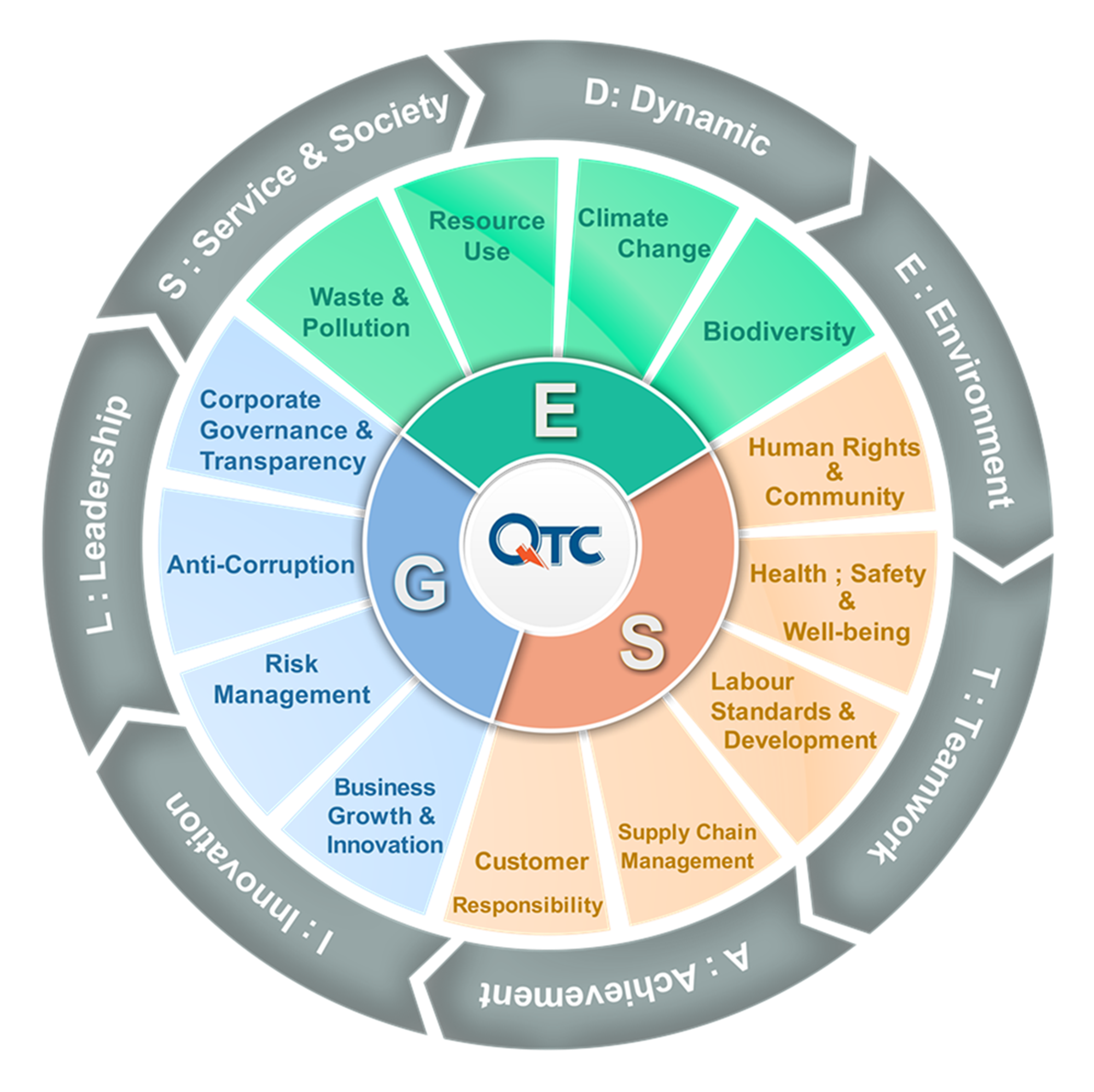
The Sustainable Development Policy of QTC Energy Public Company Limited focuses on conducting business in accordance with ESG principles to create a balance among environmental, social, and governance dimensions. The Company places strong emphasis on transparent management, anti-corruption practices, and respect for human rights in line with international standards. In addition, the Company is committed to ensuring the health, hygiene, and safety of its personnel, as well as the efficient use of resources to mitigate climate impacts and preserve biodiversity. This policy also encompasses innovation development and comprehensive risk management to sustainably create shared value for all stakeholders.
Sustainability Framework
Sustainability Goals & UN SDGs
Has Sustainability Goals
Yes
Goals Description
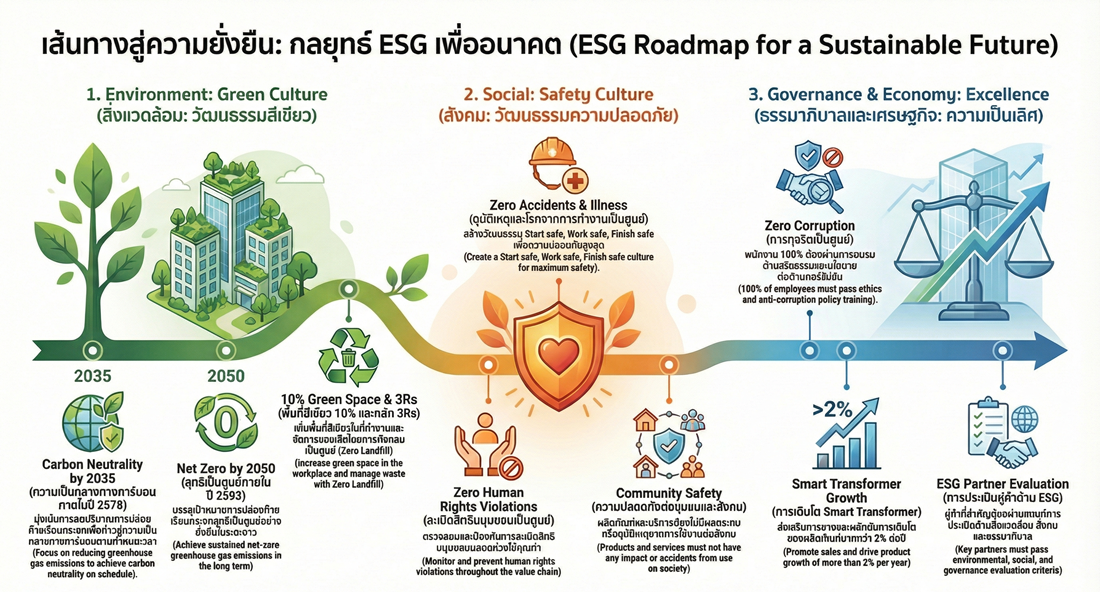
The strategic direction is designed to drive sustainable growth through three key pillars. It focuses on fostering a Green Culture, with the goal of reducing environmental impacts, progressing toward carbon neutrality, and achieving zero waste management. In terms of safety, a Safety Culture framework has been established to prevent work-related accidents and occupational illnesses, targeting zero incidents through rigorous employee training. In addition, the organization places strong emphasis on excellence in governance and economic performance, upholding ethical business practices and ensuring that business partners comply with the same standards.
With regard to product development, this strategy focuses on market expansion and innovation in energy-efficient transformer technologies, addressing social responsibility while enhancing long-term competitiveness. Ultimately, all of these approaches are designed to align with the United Nations Sustainable Development Goals (SDGs) across multiple dimensions, elevating the organization’s commitment to genuine responsibility toward both society and the planet.
UN Sustainable Development Goals
| SDG Goal |
|---|
| Goal 1 No Poverty |
| Goal 3 Good Health and Well-being |
| Goal 4 Quality Education |
| Goal 5 Gender Equality |
| Goal 7 Affordable and Clean Energy |
| Goal 8 Decent Work and Economic Growth |
| Goal 12 Responsible Consumption and Production |
| Goal 13 Climate Action |
| Goal 15 Life on Land |
| Goal 16 Peace, Justice and Strong Institutions |
| Goal 17 Partnerships for the Goals |
Policy Review
Policy Reviewed This Year
Yes
Policy Changed This Year
No
Business Value Chain
Value Chain Description
The value chain structure of QTC Energy’s business covers upstream to downstream activities, with a focus on the clean energy and electrical equipment manufacturing industries, such as transformer production and the distribution of solar power systems and clean energy equipment. The operational process includes the management of both domestic and international suppliers, manufacturing based on customer orders, product delivery, and systematic waste management. In addition, the Company identifies a wide range of stakeholders, including employees, contract workers, government agencies, and financial institutions. The value chain diagram also reflects the Company’s expansion into the electric vehicle (EV) business and investments in other alternative energy ventures, with strong emphasis on community and environmental considerations at every stage of operations, in order to build sustainability across an integrated business ecosystem.
Stakeholder Analysis
Stakeholder Analysis
| Stakeholder Type | Stakeholders | Stakeholder Expectations | Response to Expectations | Communication Activities |
|---|---|---|---|---|
| Internal stakeholders | 2921 · Description: Employees | -Appropriate salary and wage increases
-Provision of appropriate employee benefits
-Workplace safety
-A pleasant and supportive working environment
-Equality and opportunities for career advancement
-Training and development plans to enhance knowledge and skills
-Good quality of life and well-being
-Gender equality
-Protection and control of personal data to prevent data leakage | -Occupational health and safety management in accordance with ISO 45001
-Environmental management in accordance with ISO 14001
-Provident fund
-Strict compliance with employment policies
-Workplace Health Promotion Program
-Ethical and Well-being Organization Program
-Fair and transparent compensation and performance evaluation system
-Career path development
-Knowledge Management
-Individual Development Plan (IDP)
-Compliance with human rights policies
-Strict compliance with human rights policies and implementation guidelines
-Strict compliance with personal data protection policies and implementation guidelines
-Strict compliance with anti-corruption policies and implementation guidelines | 2941 · Description: Online Communication · 2942 · Description: Internal Meeting · 2945 · Description: Complaint Reception · 2946 · Description: Employee Engagement Survey · 2948 · Description: Training / Seminar · 2949 · Other name: Monthly Executive–Employee Meeting · Description: Others · 2949 · Other name: Suggestion, Kaizen, and QCC Activities · Description: Others · 2949 · Other name: Feedback Listening, Grievance Box, and Employee Complaints · Description: Others · 2949 · Other name: Welfare Committee and Safety Committee meetings held once a month · Description: Others · 2949 · Other name: Annual Employee Happiness Survey (conducted once a year) · Description: Others · 2949 · Other name: Annual Employee Engagement Survey (conducted once a year) · Description: Others · 2949 · Other name: Enterprise Risk Assessment conducted quarterly) · Description: Others · 2949 · Other name: Safety Risk Assessment and Environmental Impact Assessment conducted annually · Description: Others |
| External stakeholders | 2913 · Description: Shareholders | * Good returns
* Good corporate governance
* Stable and sustainable business growth
* Accurate, complete, timely, and transparent company information
* Enterprise risk management
* Effective audit and control systems
* Equal opportunities
* Personal data protection
| * Transparent, fair, and auditable corporate governance
* Appropriate dividend payments
* Transparent disclosure of information
* Development of clear business strategic plans
* Prudent risk management
* Strict compliance with human rights policies and implementation guidelines
* Strict compliance with personal data protection policies and implementation guidelines
* Strict compliance with anti-corruption policies and implementation guidelines
| 2938 · Description: Visit · 2939 · Description: Press Release · 2941 · Description: Online Communication · 2943 · Description: External Meeting · 2944 · Description: Annual General Meeting (AGM) · 2945 · Description: Complaint Reception |
| External stakeholders | 2923 · Description: Customers | * Accurate technical information on products and services
* Reasonable pricing of products and services
* Transparent price competition
* High-quality products and services
* Fair compliance with contractual agreements
* Availability of energy-saving products that help reduce greenhouse gas emissions
* Product and service warranties
* Protection of customer data confidentiality
* Safety in the use of products
* Respect for human rights throughout the value chain
* Responsibility toward the environment, society, and good corporate governance
* Full electricity supply in accordance with contractual terms
* Sharing of knowledge and technology in the energy sector
* Fast, accurate, and demand-oriented technical information on products and services
* Reasonable and competitive pricing of products and services
* Product quality that meets requirements
* On-time delivery
* Effective pre-sales and after-sales services
* Ability to assist customers in problem resolution
| * Good corporate governance that is transparent and auditable
* Strict compliance with anti-corruption policies and implementation guidelines
* Quality management in accordance with ISO 9001
* Environmental management in accordance with ISO 14001
* Occupational health and safety management in accordance with ISO 45001
* Organizational management based on TQM standards to improve processes, products, and services
* Customer relationship management through a CRM system
* Strict compliance with personal data protection policies and implementation guidelines
* Strict compliance with human rights policies and implementation guidelines
* Product certification in accordance with ISO 17025 laboratory standards
* Development of energy-saving products by the R\&D team
* Factory visits and production process tours
* Invitations to visit power generation facilities to build confidence
* Improvement and maintenance of power generation equipment to ensure maximum efficiency
* Strict compliance with contractual terms and conditions
* Preparation of product catalogs, user manuals, and other documents with accurate technical information
* Planning and control of work processes to ensure efficiency and achieve the lowest possible costs
* Planning and control of vendors in accordance with contractual agreements
* Establishment of a Technical Support team
* Development of product-related media without exaggerated or misleading advertising
| 2938 · Description: Visit · 2941 · Description: Online Communication · 2945 · Description: Complaint Reception · 2947 · Description: Satisfaction Survey · 2948 · Description: Training / Seminar · 2949 · Other name: Customer / Sales Representative Visits · Description: Others · 2949 · Other name: Trade Fair / Exhibition Participation · Description: Others · 2949 · Other name: Providing academic and technical knowledge to customers and sales representatives · Description: Others · 2949 · Other name: Providing opportunities for customers and sales representatives to visit the production process · Description: Others · 2949 · Other name: Joint activities with customers and sales representatives · Description: Others |
| External stakeholders | 2899 · Description: Suppliers | * Accurate and timely information provided in accordance with agreed timelines
* Fair compliance with contractual agreements and payment terms
* Fair and transparent price competition
* Knowledge sharing and development of raw material production processes
* Personal data protection
| * Strict compliance with procurement policies, sourcing policies, and operating procedures
* Supplier development through guidance, knowledge sharing, and support to enhance raw material quality beyond required standards
* Compliance with anti-corruption policies and promotion of ethical practices
* No Gift Policy
* Code of Conduct for QTC’s Suppliers
* Strict compliance with personal data protection policies and implementation guidelines
| 2938 · Description: Visit · 2949 · Other name: Annual supplier and contractor evaluation · Description: Others · 2949 · Other name: Inspection of production processes and raw material quality · Description: Others · 2949 · Other name: Development-focused discussions · Description: Others · 2949 · Other name: Briefing meetings and discussions with key suppliers · Description: Others |
| External stakeholders | 2900 · Description: Business partners | * Achieving the objectives of the brand owner / product manufacturer
* Building brand awareness in Thailand
* Building strong relationships between brand owners / product manufacturers and distributors
* Personal data protection
| * Setting sales targets aligned with the brand owner
* Establishing a dedicated solar business sales team separate from the transformer business
* Establishing a dedicated technical support team for the solar business
* Organizing joint sales support activities
* Providing product knowledge training for sales staff
* Sharing sales data with the product owner
* Strict compliance with anti-corruption policies and implementation guidelines
* Strict compliance with personal data protection policies and implementation guidelines
| 2938 · Description: Visit · 2939 · Description: Press Release · 2949 · Other name: Inquiring about the objectives of the brand owner / product manufacturer · Description: Others · 2949 · Other name: Participation in meetings and activities organized by the brand owner / product manufacturer · Description: Others · 2949 · Other name: Participation in training and testing in accordance with the product owner’s requirements · Description: Others |
| Internal stakeholders | 2897 · Description: Board of director | * Compliance with laws and ethical principles
* Transparent and auditable practices
* Business success
* Responsibility toward the environment, society, and good corporate governance
* Protection and control of directors’ personal data
| * Good corporate governance in accordance with established policies and strict enforcement
* Strict compliance with various policies and effective implementation in practice
* Development of business plans aligned with organizational goals
* Professional enterprise risk management
* Compliance with personal data protection policies
* Transparent quarterly performance reporting
| 2942 · Description: Internal Meeting · 2944 · Description: Annual General Meeting (AGM) · 2949 · Other name: Board of Directors’ Meeting · Description: Others · 2949 · Other name: Audit Committee Meeting · Description: Others · 2949 · Other name: Nomination, Remuneration, and Corporate Governance Committee Meeting · Description: Others · 2949 · Other name: Leadership Performance Evaluation · Description: Others |
| External stakeholders | 2936 · Other name: Trade receivables · Description: Others | -Negotiation and flexibility
-Personal data protection
|
-Negotiation
-Accounts receivable management and trade credit risk management policies
-Legal actions
-Strict compliance with personal data protection policies and implementation guidelines
| 2949 · Other name: Meetings and discussions to follow up on outstanding receivables and listen to concerns · Description: Others |
| External stakeholders | 2894 · Description: Creditor | -bility to comply with contractual terms and conditions
-Transparency in business operations
-Personal data protection
| -Strict compliance with contractual terms and conditions
-Strict compliance with anti-corruption policies and implementation guidelines
-Strict compliance with personal data protection policies and implementation guidelines
-Facility / business visits | 2944 · Description: Annual General Meeting (AGM) · 2945 · Description: Complaint Reception · 2949 · Other name: Meetings and discussions · Description: Others |
| External stakeholders | 2902 · Description: Community | -Being good neighbors and maintaining friendly relationships
-Supporting community activities
-Supporting local products and community goods
-Causing no negative impact on the community in terms of safety and the environment
-Preserving the balance of biodiversity in the community
-Transparency in operations
-Adherence to human rights principles and anti-corruption practices | -Supporting public activities
-Building a volunteer workforce to participate in public activities
-Environmental management in accordance with ISO 14001 standards
-Occupational health and safety management in accordance with ISO 45001 standards
-Allocating appropriate budgets to support community projects and activities
-Compliance with human rights policies and promotion of their implementation
-Compliance with anti-corruption policies and promotion of ethical practices
-Strict compliance with personal data protection policies and implementation guidelines
-Purchasing products from persons with disabilities in the community, where appropriate to business operations
Investing indirectly in social enterprises as appropriate
-Annual performance reporting through public forums and other communication channels | 2939 · Description: Press Release · 2940 · Description: Social Event · 2941 · Description: Online Communication · 2943 · Description: External Meeting · 2945 · Description: Complaint Reception · 2949 · Other name: Community engagement activities · Description: Others · 2949 · Other name: Participation in community development · Description: Others · 2949 · Other name: Annual Community Dialogue Forum: “Community Meets QTC” and Annual “Community Visits the Power Plant” Activities · Description: Others · 2949 · Other name: Participation in meetings with local community leaders · Description: Others |
| External stakeholders | 2926 · Description: Educational institution or academic agency | * Students gain knowledge and skills relevant to their field of study
* Safety and a good working environment during internships
* Gender equality
* Protection of personal data to prevent data leakage
| * Assigning interns to appropriate departments aligned with their field of study, with periodic monitoring and evaluation
* Providing additional training on work practices, treating interns similarly to company employees
* Occupational health and safety management in accordance with ISO 45001 standards
* Environmental management in accordance with ISO 14001 standards
* Strict compliance with human rights policies and implementation guidelines
* Strict compliance with personal data protection policies and implementation guidelines
* Providing basic welfare benefits equivalent to those of employees
* Providing guidance and advice on project work
* Providing appropriate compensation to interns
* Assessing intern engagement and commitment
| 2938 · Description: Visit · 2943 · Description: External Meeting · 2948 · Description: Training / Seminar · 2949 · Other name: Formally inquiring about and listening to the expectations of students and academic advisors during the internship period · Description: Others · 2949 · Other name: Participating in meetings to discuss guidelines for developing students’ skills at various educational institutions · Description: Others |
| External stakeholders | 2936 · Other name: Waste disposal service provider · Description: Others | * Strict compliance with terms and conditions
*Lawful operations in accordance with applicable regulations
* Fair and impartial consideration in the selection process
* Personal data protection
| -Performance evaluation of waste disposal contractors
-Strict compliance with anti-corruption policies and implementation guidelines
-Strict compliance with personal data protection policies and implementation guidelines | 2948 · Description: Training / Seminar · 2949 · Other name: Knowledge sharing on legal requirements and proper practices · Description: Others · 2949 · Other name: On-site inspections and assessments, and listening to feedback · Description: Others |
| External stakeholders | 2931 · Description: Government agencies and Regulators | -Ability to comply with relevant laws and regulatory requirements
-Enhancing organizational capabilities to participate in improving production processes to be environmentally friendly and reduce impacts on biodiversity
-Cooperation in providing information to government agencies for development purposes
-Supporting government projects that benefit the public
-Responsibility toward the environment, society, and good corporate governance
-Contributing to the development of a strong and sustainable Thai economy | -Strict compliance with all applicable laws, regulations, and legal requirements related to business operations
-Full and timely payment of all applicable taxes
-Development of processes to identify improvement opportunities and reduce environmental impacts
-Providing supporting information to government agencies for analytical and development purposes
-Transparent disclosure of information
-Reporting information as required by law
-Annual report | 2939 · Description: Press Release · 2941 · Description: Online Communication · 2948 · Description: Training / Seminar · 2949 · Other name: Briefing Meeting by Government Agencies · Description: Others · 2949 · Other name: Inspection / Site Visit · Description: Others · 2949 · Other name: Conditions in accordance with applicable legal requirements for business operations and internationally recognized practices · Description: Others · 2949 · Other name: Information and news updates · Description: Others |
| External stakeholders | 2936 · Other name: Business competitors · Description: Others | -Fair and transparent competition
-Exchange of information and updates on products, sources of raw materials, as well as production tools and machinery | Adherence to ethical principles for fair and transparent business operations | 2949 · Other name: Meetings and discussions, information sharing, member group meetings, and marketing activities · Description: Others |
| External stakeholders | 2929 · Description: Media | -Accurate and timely disclosure of business information and operational progress
-Personal data protection and control | -Conduct meetings and courtesy visits with the media at least once a year
-Invite media representatives to visit and observe the Company’s operations
-Strictly comply with the personal data protection policy and related guidelines | 2938 · Description: Visit · 2939 · Description: Press Release |
| External stakeholders | 2936 · Other name: External communities and broader society · Description: Others | -Supporting various activities for public benefit
-Providing support for goods and products
-Providing assistance in the event of disasters
-Avoiding the creation of negative social impacts | -Provide support for public-benefit activities and donations in alignment with the -Company’s context and capabilities
-Promote and develop employee volunteer programs to participate in public and community activities
-Procure goods and products from social enterprises
-Make indirect investments in social enterprises as appropriate
-Disclose and report annual operational performance
-Organize and participate in seminars and public dialogue activities | 2939 · Description: Press Release · 2945 · Description: Complaint Reception · 2949 · Other name: Letters requesting support on various matters · Description: Others · 2949 · Other name: Conduct site visits to engage in discussions and assess needs · Description: Others |
Environmental Policy & Guidelines
Has an Environmental Policy
Yes
Policy Description
QTC Energy Public Company Limited is committed to conducting its business with responsibility toward the environment and society, recognizing the direct and indirect environmental impacts of its operations. The Company places importance on the efficient use of resources—including raw materials for production, electricity, fuel, and water—pollution prevention and reduction, proper waste management, biodiversity conservation, and the reduction of greenhouse gas emissions to support the transition toward a low carbon economy. The Company promotes environmental knowledge, awareness, and accountability among employees and business partners, while providing the necessary resources for effective management. This policy is strictly implemented to ensure environmentally responsible operations and to foster a sustainable green organizational culture. "Green culture"
Environmental Guidelines
| Guideline |
|---|
| Electricity Management |
| Fuel Management |
| Renewable/Clean Energy Management |
| Water Management |
| Waste Management |
| Biodiversity Management |
| Greenhouse Gas and Climate Change Management |
| Air Quality Management |
Environmental Policy Review
Policy Reviewed This Year
Yes
Review Details
The Energy Conservation Policy has been separated from the Environmental Policy to provide greater clarity and to ensure compliance with relevant laws and regulations.
Policies & Guidelines Changed
| Change |
|---|
| Electricity Management |
Energy — Plan & Guidelines
Has an Energy Management Plan
Yes
Plan Description
The main operational plan focuses solely on activities within QTC Energy Public Company Limited and does not yet include any subsidiaries.
Energy — Electricity Consumption
Electricity Consumption
| Metric | Current Year | Previous Year | Two Years Ago |
|---|---|---|---|
| Total electricity consumption within the organization (Kilowatt-Hours) | 2,679,299.84 | 2,250,207 | 1,771,455.65 |
| Electricity purchased for consumption from non-renewable energy sources (Kilowatt-Hours) | 2,196,691 | 1,942,396 | 1,593,465 |
| Electricity purchased or generated for consumption from renewable energy sources (Kilowatt-Hours) | 482,608.84 | 307,811 | 177,990.65 |
Energy — Fuel Consumption
Fuel Consumption
| Metric | Current Year | Previous Year | Two Years Ago |
|---|---|---|---|
| Crude oil (Barrels) | |||
| Coal (Metric tonnes) | |||
| Jet fuel (Litres) | |||
| Diesel (Litres) | 84,226.47 | 88,378 | 88,714.13 |
| Gasoline (Litres) | 39,648.04 | 37,615 | 35,335.56 |
| Fuel oil (Litres) | |||
| Natural gas (Standard cubic feet) | |||
| LPG (Kilograms) | |||
| Steam (Metric tonnes) |
Energy — Targets
Has Set Targets
Yes
Targets
| Target | Base Year | Base Year Value | Target Year | Target Year Value | Target Change (%) | Unit | Per Unit (Intensity) | Per Unit — Please Specify |
|---|---|---|---|---|---|---|---|---|
| Reduction of electricity purchased for consumption | 2,021 | 1,669.27 | 2,025 | 1,335.42 | 20 | Kilowatt-hour | Other | Total Revenue (Million Baht) |
| Reduction of fuel consumption | 2,021 | 83.93 | 2,025 | 67.14 | 20 | Litres | Other | Total Revenue (Million Baht) |
Energy — Performance & Outcomes
Has Performance Results
Yes
Performance Description
Electricity and Fuel Consumption per Revenue
(Consolidated for All Companies within the QTC Energy Group)
The Group’s energy performance is assessed by measuring energy efficiency through a comparison of energy consumption per total revenue (Energy Intensity), as detailed below.
1. Electricity Efficiency
Electricity efficiency demonstrates strong sustainability performance in electricity usage, as the ratio of electricity consumption per revenue has been significantly reduced.
Trend:
Compared with the base year 2021, when electricity consumption was 1,669.27 kilowatt-hours per THB 1 million of total revenue, the figure declined continuously to 1,513.32 in 2022 and reached its lowest level in 2023 at 1,170.88.Sustainability Aspect:
The substantial reduction compared with the base year, particularly in 2023, reflects the Company’s ability to generate revenue growth while using fewer electricity resources (decoupling). Although the ratio increased slightly in 2024 and 2025 to 1,259.24 and 1,359.76, respectively, overall electricity consumption efficiency remains better than in the base year.
2. Fuel Efficiency
Sustainability performance in fuel consumption shows greater volatility and did not meet the target during the initial period.
Trend:
Compared with the base year 2021, when fuel consumption was 83.93 liters per THB 1 million of revenue, efficiency declined in 2022 and 2023, with fuel consumption increasing to 87.83 and 91.15 liters per THB 1 million of revenue, respectively. This trend was contrary to the target of a 5% annual reduction.Sustainability Aspect:
The increase in fuel consumption intensity during 2022–2023 indicates that business revenue growth did not keep pace with fuel usage, or that operations became more energy-intensive. However, the trend began to improve in 2024 and 2025, with the ratio decreasing to 81.68 and 76.68, respectively, which is lower than the base year. This reflects an improvement in resource management efficiency relative to revenue in the later period.
Conclusion
Overall, the assessment of energy efficiency relative to revenue indicates that the business demonstrates strong sustainability performance in electricity usage as a key strength. In contrast, fuel consumption efficiency faced challenges during the initial years but began to improve and exceeded base-year performance during 2024–2025.

Water — Plan & Guidelines
Has a Water Management Plan
No
Plan Description
As the Company’s business operations do not require water for production processes or as a primary raw material, water is used solely for domestic consumption within the organization. Therefore, the Company places importance on water conservation and ensures that no wastewater is discharged into the public environment. Water consumption is regularly monitored and measured to verify performance, and a target has been established to limit annual water consumption per employee to not exceed the baseline year of 2021 (B.E. 2564).
Water — Withdrawal, Discharge & Consumption
Water Withdrawal, Discharge & Consumption
| Metric | Current Year | Previous Year | Two Years Ago |
|---|---|---|---|
| Total water withdrawal (Cubic meters) | 13,741 | 14,545 | 15,288 |
| Total water withdrawal by third-party water (Cubic meters) | 1,033 | 2,168 | 1,392 |
| Total water withdrawal by surface water (Cubic meters) | |||
| Total water withdrawal by groundwater (Cubic meters) | 12,708 | 12,377 | 13,896 |
| Total water withdrawal by seawater (Cubic meters) | |||
| Total water withdrawal by produced water (Cubic meters) | |||
| Percentage of wastewater treated before discharge (%) | |||
| Total water discharge (Cubic meters) | 13,741 | 14,545 | 15,288 |
| Total water discharge to third-party water (Cubic meters) | 1,033 | 2,168 | 1,392 |
| Total water discharge to surface water (Cubic meters) | 3,668 | 4,153 | 5,027 |
| Total water discharge to groundwater (Cubic meters) | 9,040 | 8,224 | 8,869 |
| Total water discharge to seawater (Cubic meters) | |||
| Total water consumption (Cubic meters) | 0 | 0 | 0 |
| Recycled water (Cubic meters) | 0 | 0 | 0 |
Water — Targets
Has Set Targets
Yes
Targets
| Target | Base Year | Base Year Value | Target Year | Target Year Value | Target Change (%) | Unit | Per Unit (Intensity) | Per Unit — Please Specify |
|---|---|---|---|---|---|---|---|---|
| Reduction of water withdrawal | 2,021 | 56.45 | 2,025 | 45.16 | 20 | Cubic meters | Person(employee) | Person(employee) |
Water — Performance & Outcomes
Has Performance Results
Yes
Performance Description
Water Consumption per Employee
(Including Employees and Non-Employee Workers, Consolidated for All Companies within the QTC Energy Group)
Based on the analysis of water consumption data, the overall trend of water usage per employee shows a continuous decline. This reflects excellent water management efficiency. When compared with the base year 2021, in which water consumption amounted to 56.45 cubic meters per person, water usage per employee has decreased significantly in the subsequent years.
The trends and performance for each year are summarized as follows:
2022: Water consumption decreased to 47.93 cubic meters per person, representing a substantial reduction compared with the base year.
2023: Water consumption increased slightly to 48.84 cubic meters per person; however, the level remained lower than that of the base year.
2024 and 2025: Water management efficiency continued to improve, with water consumption declining further to 42.28 and 36.16 cubic meters per person, respectively.
In terms of management efficiency, the results demonstrate the Company’s capability to control resource consumption in alignment with its established target of “reducing water consumption by 5% annually from the base year 2021.” The reduction in water consumption from 56.45 cubic meters per person in 2021 to 36.16 cubic meters per person in 2025 clearly indicates the tangible success of the water conservation measures implemented.
Waste — Plan & Guidelines
Has a Waste Management Plan
Yes
Plan Description
The Company’s waste and waste management practices are based on the 3Rs principle (Reduce, Reuse, and Recycle), with the goal of minimizing waste sent for disposal. The Company aims to achieve zero waste to incineration and landfill, thereby reducing environmental impacts and promoting sustainable resource management.
Waste — Generation, Disposal & Recycling
Waste Generation, Disposal & Recycling
| Metric | Current Year | Previous Year | Two Years Ago |
|---|---|---|---|
| Total waste generated (Kilograms) | 597,644 | 437,400 | 249,890 |
| Non-hazardous waste (Kilograms) | 467,268 | 331,010 | 177,580 |
| Non-hazardous waste - Landfilling (Kilograms) | 750 | 700 | 70 |
| Non-hazardous waste - Incineration (with energy recovery) (Kilograms) | 0 | 0 | 0 |
| Non-hazardous waste - Incineration (without energy recovery) (Kilograms) | 0 | 1,850 | 1,700 |
| Non-hazardous waste - Other disposal operations (Kilograms) | 466,518 | 328,460 | 175,810 |
| Hazardous waste (Kilograms) | 130,376 | 106,390 | 72,310 |
| Hazardous waste - Landfilling (Kilograms) | 0 | 0 | 0 |
| Hazardous waste - Incineration (with energy recovery) (Kilograms) | 105,100 | 57,060 | 37,750 |
| Hazardous waste - Incineration (without energy recovery) (Kilograms) | 640 | 2,070 | |
| Hazardous waste - Other disposal operations (Kilograms) | 25,276 | 48,690 | 32,490 |
| Total reused/recycled waste (Kilograms) | 515,208 | 360,950 | 205,890 |
| Reused/Recycled non-hazardous waste (Kilograms) | 466,518 | 328,460 | 175,810 |
| Reused non-hazardous waste (Kilograms) | 0 | 0 | 0 |
| Recycled non-hazardous waste (Kilograms) | 466,518 | 328,460 | 175,810 |
| Reused/Recycled hazardous waste (Kilograms) | 48,690 | 32,490 | 30,080 |
| Reused hazardous waste (Kilograms) | 0 | 0 | 0 |
| Recycled hazardous waste (Kilograms) | 48,690 | 32,490 | 30,080 |
Waste — Targets
Has Set Targets
Yes
Targets
| Waste Type | Disposal Approach | Target | Base Year | Base Year Value | Target Year | Target Year Value | Target Change (%) | Unit |
|---|---|---|---|---|---|---|---|---|
| Hazardous waste | 2760 · Description: Landfilling | Reduce waste volume | 2,022 | 0.06 | 2,028 | 0 | 100 | Tonne |
| Non-hazardous waste and hazardous waste | 2762 · Description: Incineration without energy recovery | Reduce waste volume | 2,022 | 33.06 | 2,028 | 6.94 | 21 | Tonne |
Waste — Performance & Outcomes
Has Performance Results
Yes
Performance Description
Reduction of Hazardous Waste through Landfill Disposal
In the base year 2022, the Company generated 0.06 tons of hazardous waste that required disposal by landfill. During the period from 2023 to 2025, however, no hazardous waste was disposed of through landfill. The amount of hazardous waste disposed of by landfill was continuously reduced to zero throughout all three years. This demonstrates a significant improvement in the effectiveness of hazardous waste management processes, enabling the Company to achieve a 100% reduction in hazardous waste compared with the base year. As a result, the Company has achieved its target for reducing hazardous waste disposed of by landfill, as set for the year 2028, since 2023 onward.
These outcomes reflect the strength of the Company’s control systems, waste segregation practices, and upstream hazardous waste management based on the 3Rs principle (Reduce, Reuse, Recycle). Such measures have effectively mitigated environmental risks and reduced potential impacts on surrounding communities in a tangible manner.
Reduction of Non-Hazardous and Hazardous Waste through Incineration without Energy Recovery
With respect to non-hazardous and hazardous waste disposed of through incineration without energy recovery, the amount recorded in the base year 2022 was as high as 33.06 tons. However, performance over the subsequent three years demonstrates a continuous downward trend. In 2023, the amount was reduced to 3.77 tons, followed by a further reduction to 2.49 tons in 2024, before being successfully reduced to zero tons in 2025.
When compared with the target set for 2028, which aims to reduce this type of waste by 21%, or 6.94 tons, from the base year, it is evident that the Company’s actual performance significantly exceeds the established target. The complete elimination of both hazardous and non-hazardous waste disposed of through incineration without energy recovery by 2025 highlights the Company’s success in transforming its waste management approach toward more efficient and environmentally friendly processes.

GHG — Plan & Guidelines
Has a GHG Management Plan
Yes
Plan Description
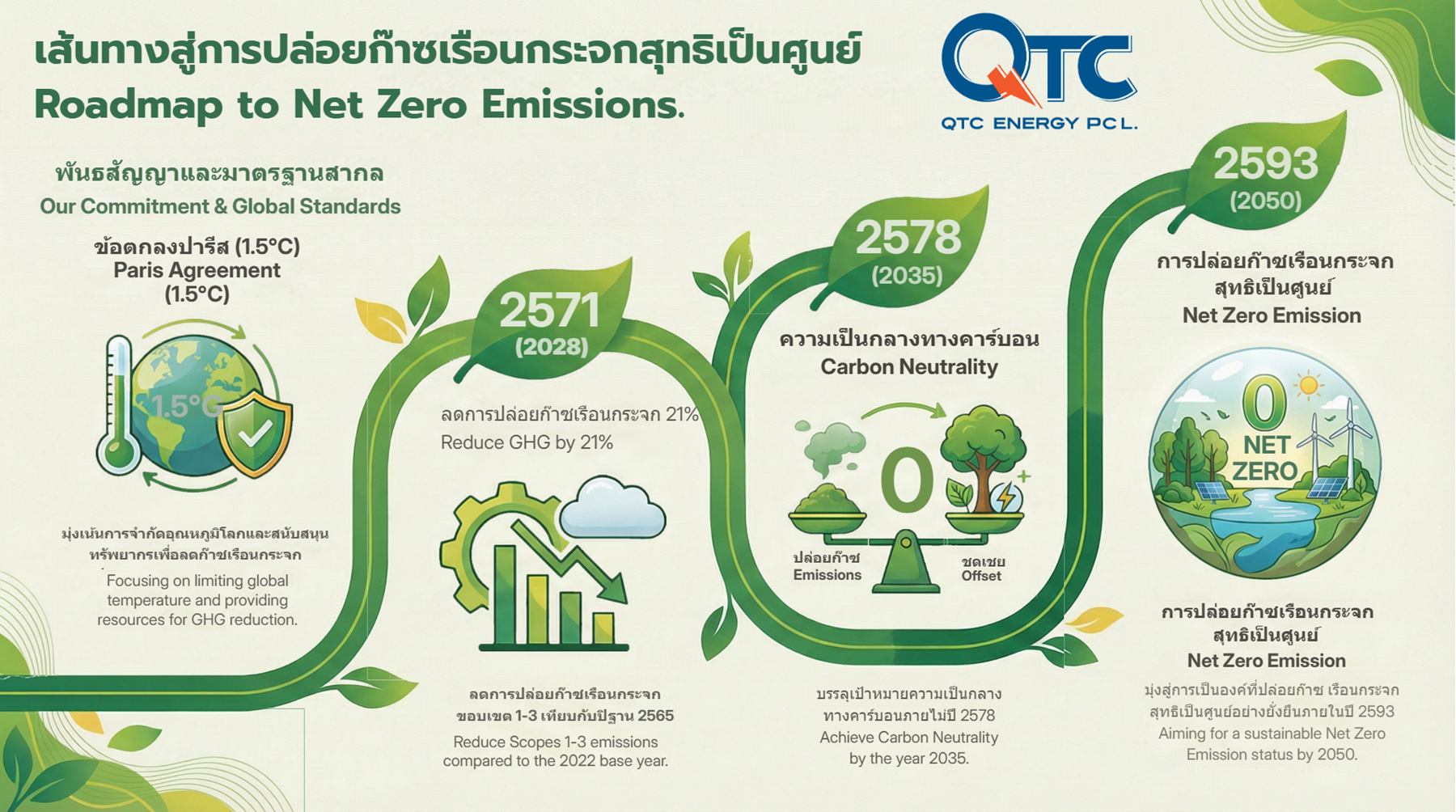
QTC Energy Public Company Limited places strong emphasis on and recognizes its responsibilities toward society and the environment. The Company is committed to establishing greenhouse gas (GHG) emission reduction targets that are aligned with the goals of the Paris Agreement, which aims to limit the global average temperature increase to no more than 1.5 C.
The Company pledges to provide the necessary personnel and resources to support the implementation of plans and activities for the reduction and/or removal of greenhouse gas emissions in order to achieve the following objectives:
Greenhouse Gas Reduction Target over a 5-Year Period (Net Zero Pathway):
To reduce greenhouse gas emissions across Scopes 1, 2, and 3 by 21% by 2028, compared to the base year 2022.Carbon Neutrality Target:
To achieve carbon neutrality by 2035.Net Zero Emissions Target:
To achieve net zero greenhouse gas emissions by 2050.
GHG — Emissions
GHG Emissions
| Metric | Current Year | Previous Year | Two Years Ago |
|---|---|---|---|
| Total GHG emissions (Metric tonnes of carbon dioxide equivalent) | 2,592 | 1,935 | 1,772 |
| Total greenhouse gas emissions 1 (Metric tonnes of carbon dioxide equivalent) | 357 | 356 | 340 |
| Total greenhouse gas emissions 2 (Metric tonnes of carbon dioxide equivalent) | 1,040 | 931 | 762 |
| Total greenhouse gas emissions 3 (Metric tonnes of carbon dioxide equivalent) | 1,195 | 648 | 670 |
GHG — Emissions Verification
Emissions Verified by a Third Party
Yes
Verifying Body
2650
GHG — Principles & Standards
Principles & Standards Applied
| Standard |
|---|
| 2671 |
| 2672 |
| 2677 |
GHG — Targets
Has Set GHG Targets
Yes
GHG Targets — Net Zero
Net Zero Targets
| Emission Scope | TGO Certification | Base Year | Base Year Emissions | Near-term Target Year | Near-term Target Value | Near-term Target Change (%) | Long-term Target Year | Long-term Target Value | Long-term Target Change (%) | Target Year | Target Year Emissions | Target Change (%) | Unit |
|---|---|---|---|---|---|---|---|---|---|---|---|---|---|
| 2716 | Net zero pathway | 2,022 | 1,840 | 2,028 | 1,446 | 21 | 2,050 | 0 | 100 | 2,028 | 1,446 | 21 | Metric tonnes of carbon dioxide equivalent |
GHG Targets — Carbon Neutrality
Carbon Neutrality Targets
| Emission Scope | Carbon Neutrality Certified | Base Year | Base Year Emissions | Target Year | Target Year Emissions | Target Change (%) | Unit |
|---|---|---|---|---|---|---|---|
| 2715 | N | 2,022 | 1,208 | 2,035 | 0 | 100 | Metric tonnes of carbon dioxide equivalent |
GHG Targets — Other Targets
Other GHG Targets
| Emission Scope | Base Year | Base Year Emissions | Near-term Target Year | Near-term Target Value | Near-term Target Change (%) | Long-term Target Year | Long-term Target Value | Long-term Target Change (%) | Target Year | Target Year Emissions | Target Change (%) | Unit | Per Unit (Intensity) | Per Unit — Please Specify |
|---|---|---|---|---|---|---|---|---|---|---|---|---|---|---|
| 2716 | 2,022 | 2.28 | 2,028 | 1.8 | 21 | 2,050 | 0 | 100 | 2,028 | 1.8 | 21 | Metric tonnes of carbon dioxide equivalent | Other | Total Revenue (Million Baht) |
GHG — Performance & Outcomes
Has Performance Results
Yes
Performance Description
The performance of the greenhouse gas emission reduction projects was evaluated by comparing the projected emission reductions with the actual results achieved during Pathway Year 1 (2024) and Pathway Year 2 (2025). The assessment covers greenhouse gas emissions across Scopes 1, 2, and 3.
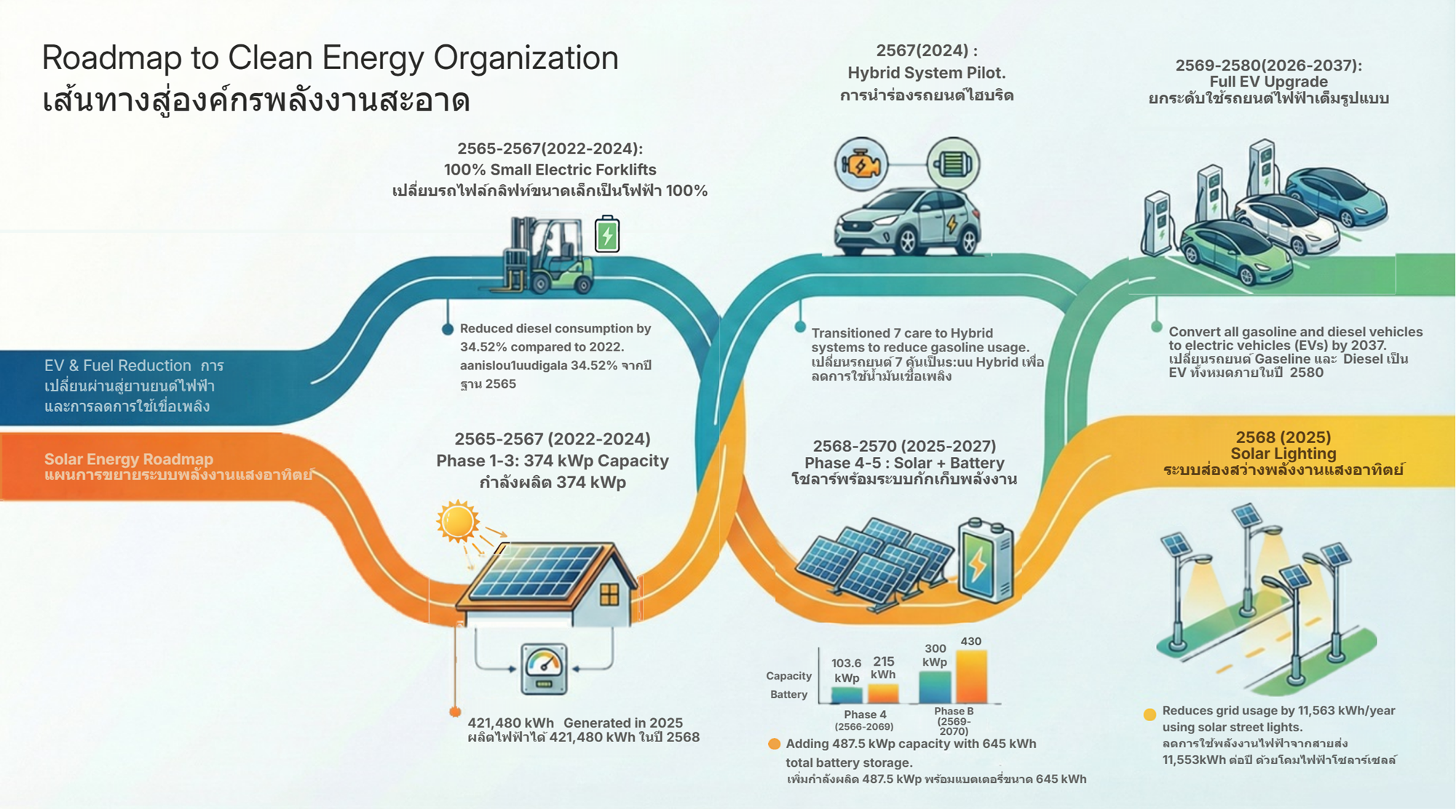
Key initiatives include the transition to hybrid vehicles, the adoption of electric forklifts, and the installation of solar rooftop systems. In addition, waste management measures aimed at reducing waste incineration, as well as the installation of solar-powered lighting to replace conventional electrical systems, were also implemented.
These initiatives demonstrate the greenhouse gas reduction potential of each project, while the variance between projected and actual results clearly reflects the operational efficiency of implementation. This evaluation serves as an important tool for tracking progress toward the Company’s long-term sustainability objectives.
Environmental Legal Incidents
Legal Violation Incidents
| Metric | Current Year | Previous Year | Two Years Ago |
|---|---|---|---|
| Number of cases or incidents of legal violations or negative environmental impact (cases) | 0 | 0 | 0 |
Human Rights Due Diligence
Conducts Human Rights Due Diligence
Yes
Due Diligence Description
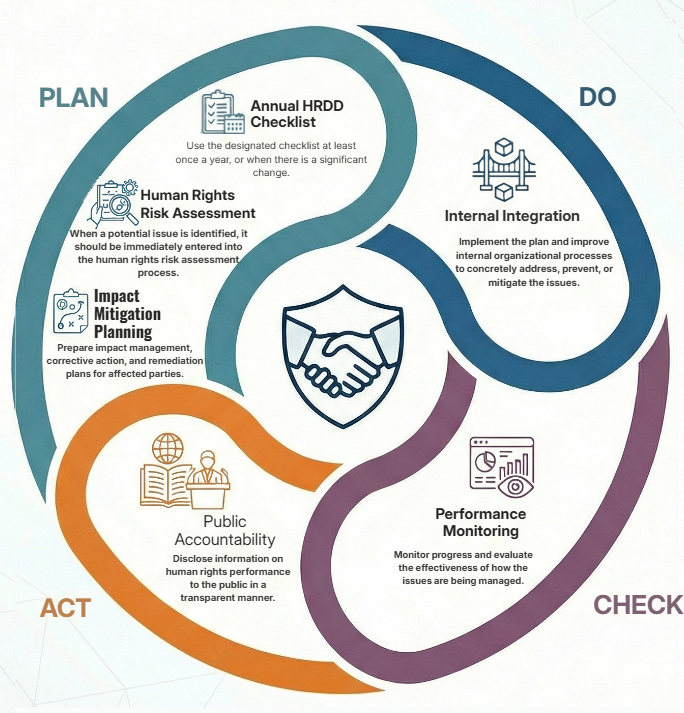
Human Rights Due Diligence is a continuous improvement process adopted by QTC Energy Public Company Limited and all its subsidiaries to identify and manage impacts on people. This process integrates five core operational steps with a cyclical PDCA (Plan–Do–Check–Act) framework, enabling systematic management of relevant issues and transparent reporting of performance.
Employees — Plan & Guidelines
Has an Employee Management Plan
Yes
Plan Description
Employee and Labor Management Plan
of QTC Energy Public Company Limited and All Subsidiaries
1. Fair Remuneration for Employees
The Company places strong emphasis on providing fair and appropriate wages, compensation, and employee benefits. Compensation is determined based on job roles and responsibilities, knowledge, skills, experience, economic conditions, cost of living, and prevailing labor market rates. Wages are paid in compliance with applicable legal requirements, not lower than the statutory minimum wage, and are disbursed accurately and on time.
In addition, the Company has established a fair, transparent, and verifiable performance evaluation system, which serves as a basis for compensation adjustments and career advancement, ensuring equitable and appropriate consideration for all employees.
2. Employee Training and Development
The Company is committed to the continuous development of employees’ capabilities and potential in order to enhance their knowledge, skills, and professional expertise in alignment with job requirements and business direction. Training programs are provided in various areas, including professional skills, occupational health and safety, and comprehensive skill development.
The Company promotes learning through diverse approaches such as internal training, coaching and mentoring, knowledge sharing, workplace improvement activities, and opportunities for employees to demonstrate their potential. These initiatives support career progression and strengthen the organization’s overall competitiveness.
3. Promotion of Employee Relations and Engagement
The Company respects employees’ rights and freedoms to express opinions, associate, and participate constructively. Employees are encouraged to communicate openly, share ideas, and take part in organizational activities.
The Company strives to foster a positive working environment that promotes collaboration, trust, and organizational engagement, while also enhancing quality of life and work–life balance. These efforts aim to ensure employee well-being, stability, and long-term commitment to the organization.
4. Child Labor
The Company is firmly committed to respecting children’s rights and does not support or tolerate the use of child labor in any business activities. All operations strictly comply with Thai labor laws and relevant international standards.
Appropriate age verification measures are implemented throughout the recruitment and hiring process. The same policy applies to all subsidiaries and business partners across the supply chain. In cases where the law permits the employment of young workers below the standard age threshold, the Company ensures full and strict protection in accordance with legal requirements.
5. Occupational Health, Safety, and Working Environment
The Company places the highest priority on employee occupational health and safety by implementing an occupational health, safety, and working environment management system in accordance with ISO 45001 standards. This system is designed to control and reduce risks associated with workplace accidents and occupational illnesses.
The Company promotes a strong safety culture under the concept of “Start Safe – Work Safe – Finish Safe” through training programs, communication initiatives, emergency preparedness drills, and the provision of appropriate personal protective equipment (PPE). These measures aim to create a safe, healthy, and sustainable working environment for all employees.
Plan Areas
| Plan Area |
|---|
| Fair employee compensation |
| Employee training and development |
| Promoting employee relations and participation |
| Child labor |
| Occupational health and safety in workplace |
Employees — Workforce
Workforce Data
| Metric | Current Year | Previous Year | Two Years Ago | Remark |
|---|---|---|---|---|
| Total number of employees (Persons) | 348 | 305 | 287 | |
| Number of male employees (Persons) | 234 | 200 | 192 | |
| Number of female employees (Persons) | 114 | 105 | 95 | |
| Total employment of disabled persons (people) | ||||
| Total disabled employees (people) | ||||
| Total male disabled employees (people) | ||||
| Total female disabled employees (people) | ||||
| Total disabled workers who are non-employee (people) | ||||
| Contributions to the fund for promoting and improving the quality of life for disabled persons | 1 | 1 | 1 | The ‘Promotion and Development of Quality of Life for Thai Persons with Disabilities’ Project through the Creation of Livelihoods in Egg Laying Chicken Farming under Section 35. |
| Total number of male employees in operational level (Persons) | 211 | 180 | 173 | |
| Total number of male employees in management level (Persons) | 14 | 12 | 14 | |
| Total number of male employees in executive level (Persons) | 9 | 8 | 5 | |
| Total number of female employees in operational level (Persons) | 97 | 88 | 79 | |
| Total number of female employees in management level (Persons) | 14 | 14 | 14 | |
| Total number of female employees in executive level (Persons) | 3 | 3 | 2 |
Employees — Remuneration & Provident Fund
Remuneration & Provident Fund
| Metric | Current Year | Previous Year | Two Years Ago |
|---|---|---|---|
| Total disabled employees (people) | 191,794,845 | 173,224,357 | 156,660,000 |
| Total male employee remuneration (Baht) | 125,957,389 | 114,440,655 | 102,150,000 |
| Total female employee remuneration (Baht) | 65,837,456 | 58,783,702 | 54,510,000 |
| Number of employees eligible to participate in PVD (persons) | 348 | 305 | 287 |
| Total number of employees joining employee provident fund (Persons) | 166 | 145 | 148 |
| Percentage of total number of employees joining employee provident fund to total number of employees (%) | 47.7 | 47.54 | 51.57 |
| Number of PVD members / Total eligible employees (%) | 47.7 | 47.54 | 51.57 |
| Total amount of provident fund contributed by the Company (Baht) | 3,806,442 | 3,473,237 | 3,256,438 |
| Total amount of provident fund contributed by employee (baht) | 7,587,050 | 6,966,032 | 6,727,410 |
Employees — Training & Development
Training Data
| Metric | Current Year | Previous Year | Two Years Ago |
|---|---|---|---|
| Average employee training hours (Hours / Person / Year) | 38.77 | 25.38 | 26.9 |
| Employee development and training expenses (baht) | 2,184,818 | 1,651,509 | 1,301,031 |
Employees — Occupational Health & Safety
Occupational Health & Safety Data
| Metric | Current Year | Previous Year | Two Years Ago |
|---|---|---|---|
| Total number of lost time injury incidents by employees (Cases) | 1 | 2 | 6 |
Employees — Labour Relations
Labour Relations Data
| Metric | Current Year | Previous Year | Two Years Ago |
|---|---|---|---|
| Total voluntary resignations (Persons) | 42 | 28 | 40 |
| Male employees who voluntary resigned (Persons) | 33 | 23 | 24 |
| Female employees who voluntary resigned (Persons) | 9 | 5 | 16 |
| Percentage of employee turnover leaving the Company voluntarily (%) | 12.07 | 9.18 | 13.94 |
| Evaluation result of employee engagement | 1 | 1 | 1 |
Employees — Employee Representation
Employees Are Represented Collectively
Yes
Forms of Representation
| Form |
|---|
| Welfare committee |
Employees — Targets
Has Set Employee Targets
Yes
Targets
| Indicator | Target Areas | Base Year | Base Year — Description | Target Year | Target Year — Description |
|---|---|---|---|---|---|
| Number of labor disputes. | 2983 · Description: Fair employee compensation · 2989 · Description: Non-discrimination | 2,022 | -Number of complaints submitted through the Company’s grievance channels: 0 cases.
-Number of cases subject to internal mediation or review: 0 cases.
-Number of labor dispute cases recorded by the Human Resources Department: 0 cases. | 2,028 | -Number of complaints submitted through the Company’s grievance channels: 0 cases.
-Number of cases subject to internal mediation or review: 0 cases.
-Number of labor dispute cases recorded by the Human Resources Department: 0 cases. |
| Employee happiness | 2985 · Description: Promoting employee relations and participation · 2989 · Description: Non-discrimination | 2,022 | Employee happiness score was 62.1%, as measured by the Happinometer. | 2,028 | Employee happiness level > 75% |
| Employee engagement with the organization | 2983 · Description: Fair employee compensation · 2984 · Description: Employee training and development · 2985 · Description: Promoting employee relations and participation · 2987 · Description: Child labor · 2988 · Description: Safety and occupational health at work · 2989 · Description: Non-discrimination | 2,022 | Employee engagement with the organization was 79.80%. | 2,028 | Employee engagement with the organization > 80% |
| Occupational accidents | 2985 · Description: Promoting employee relations and participation · 2988 · Description: Safety and occupational health at work | 2,021 | Number of work-related accidents: 25 cases | 2,028 | Zero Accidents |
| Number of occupational illness | 2988 · Description: Safety and occupational health at work | 2,023 | Number of occupational illness cases: 2 cases | 2,028 | Number of occupational illness cases: 0 cases. |
| Percentage of employees with 3 or more years of tenure who pass the Skill Matrix assessment. | 2984 · Description: Employee training and development | 2,022 | 73.75% of all employees have a Skill Matrix score greater than 86%. | 2,028 | 100% of employees have a Skill Matrix score greater than 86% |
Employees — Performance & Outcomes
Has Performance Results
Yes
Performance Description
Based on the monitoring and evaluation of employee-related performance indicators during the period from 2023 to 2025, it was found that the organization has demonstrated positive progress across multiple dimensions and has been able to achieve both its short-term and long-term targets. The detailed analysis is as follows.
Labor Relations
The organization has consistently maintained the number of labor disputes at zero throughout the period from 2023 to 2025. This reflects the effectiveness of labor management practices, strong and positive relationships between employees and the organization, as well as transparent and fair internal communication. These results are fully aligned with the organization’s clearly defined labor relations objectives.
Employee Engagement
The level of employee engagement has shown a continuous upward trend, increasing from 79.8% in 2023 to 81.2% in 2024, and rising significantly to 85.37% in 2025. This exceeds the established target (>80%) and indicates that the organization has already achieved its long-term goal. These outcomes reflect employees’ trust, pride, and commitment to contributing to the organization’s continued success.
Employee Capability Development (Skill Matrix)
The percentage of employees with three or more years of tenure who passed the Skill Matrix assessment showed some fluctuation in the early period. However, in 2025, performance improved significantly, reaching 90.19%, which exceeds the target set for 2028 (>86%). This demonstrates the success of the organization’s systematic and continuous approach to developing employee skills, knowledge, and competencies.
Employee Happiness
Although the level of employee happiness during the period from 2023 to 2025 has not yet reached the established target (>75%), it has shown a steady improvement. The score increased from 62.1% in 2023 to 68.8% in 2025. This reflects the organization’s ongoing efforts to enhance the working environment, employee welfare, and activities aimed at improving employees’ quality of life. Nevertheless, this remains an area for continued development in the future.
Occupational Health and Safety
Data on work-related accidents and occupational illnesses highlight challenges that require continued attention. While the number of accidents decreased during the period from 2022 to 2024, it increased again in 2025. Occupational illness cases were reported only in 2023, with a total of two cases, and no cases were reported in other years. This underscores the need to continuously review and strengthen occupational health and safety measures.
Overall Summary
Overall, the organization has demonstrated strong performance in employee-related outcomes, particularly in employee engagement, skill development, and labor relations. However, opportunities remain to further enhance employee happiness and strengthen accident prevention measures in order to achieve long-term balance and sustainability in human resource management.
Customers — Plan & Guidelines
Has a Customer Management Plan
Yes
Plan Description
Customer Management Plan
1. Responsible Production and Customer-Oriented Services
QTC places the highest priority on the quality and safety of its products and services. As power transformers are specialized products associated with high-voltage electrical systems, any deficiencies may potentially affect users’ lives and property. Therefore, the Company requires that all processes—from design, manufacturing, and testing to delivery and after-sales services—be carried out with due care and responsibility at every stage.
Key management approaches include:
Manufacturing operations are conducted in accordance with international standards such as ISO 9001 and ISO/IEC 17025, as well as Total Quality Management (TQM), to ensure that products meet specified requirements and customer expectations.
Clear quality and safety targets are established, such as maintaining zero incidents arising from product usage due to substandard quality.
Efficient inspection and maintenance services for transformers are provided during the warranty period to build customer confidence and reduce operational risks.
2. Communication of Product and Service Impact Information to Customers / Consumers
QTC recognizes that accurate, complete, and transparent communication is a core element of customer responsibility. The Company has therefore established appropriate practices for communicating information related to its products and services, enabling customers to use them safely and effectively.
Key practices include:
Providing information on product specifications, operating instructions, limitations, and precautions through product manuals, nameplates, and QR codes displaying product information.
Communicating safety-related information, potential impacts arising from improper usage, and risk prevention guidelines.
Disclosing product quality and standards information in compliance with customer requirements, regulatory authorities, and stock exchange regulations.
Such communication enables customers to gain a proper understanding of the products, reduces operational risks, and fosters long-term confidence in the QTC brand.
3. Enhancement of Customer Satisfaction and Relationship Building
QTC is committed to continuously improving customer satisfaction and regards its customers as long-term business partners. The Company has established a clear and auditable Customer Relationship Management (CRM) system.
Key operational approaches include:
Conducting regular customer satisfaction surveys covering domestic sales, international sales, government sales, service operations, and logistics.
Setting a target for average customer satisfaction of no less than 90%, and utilizing survey results to analyze and improve operational processes.
Systematic handling of customer complaints, with a target of achieving 100% complaint resolution, and using complaint data to enhance product and service quality.
Developing ongoing activities and communication channels to strengthen engagement, trust, and long-term relationships between customers and the Company.
4. Protection of Customer Personal Data
QTC places great importance on the protection of customer personal data and strictly complies with applicable personal data protection laws, as well as the Company’s internal policies.
Key management measures include:
Establishing policies and guidelines for the protection of customer personal data.
Implementing access control, storage, and usage measures to ensure customer data is used only as necessary for business operations.
Setting a target of zero incidents of customer personal data breaches and continuously monitoring performance to ensure compliance.
Plan Areas
| Plan Area |
|---|
| Responsible production and services for customers |
| Communication of product and service impacts to customers/consumers |
| Development of customer satisfaction and customer relationship |
| Protection of customer personal information |
Customers — Satisfaction Results
Customer Satisfaction Results
| Metric | Current Year | Previous Year | Two Years Ago |
|---|---|---|---|
| Evaluation results of customer satisfaction | 1 | 1 | 1 |
Customers — Targets
Has Set Customer Targets
Yes
Targets
| Indicator | Target Areas | Base Year | Base Year — Description | Target Year | Target Year — Description |
|---|---|---|---|---|---|
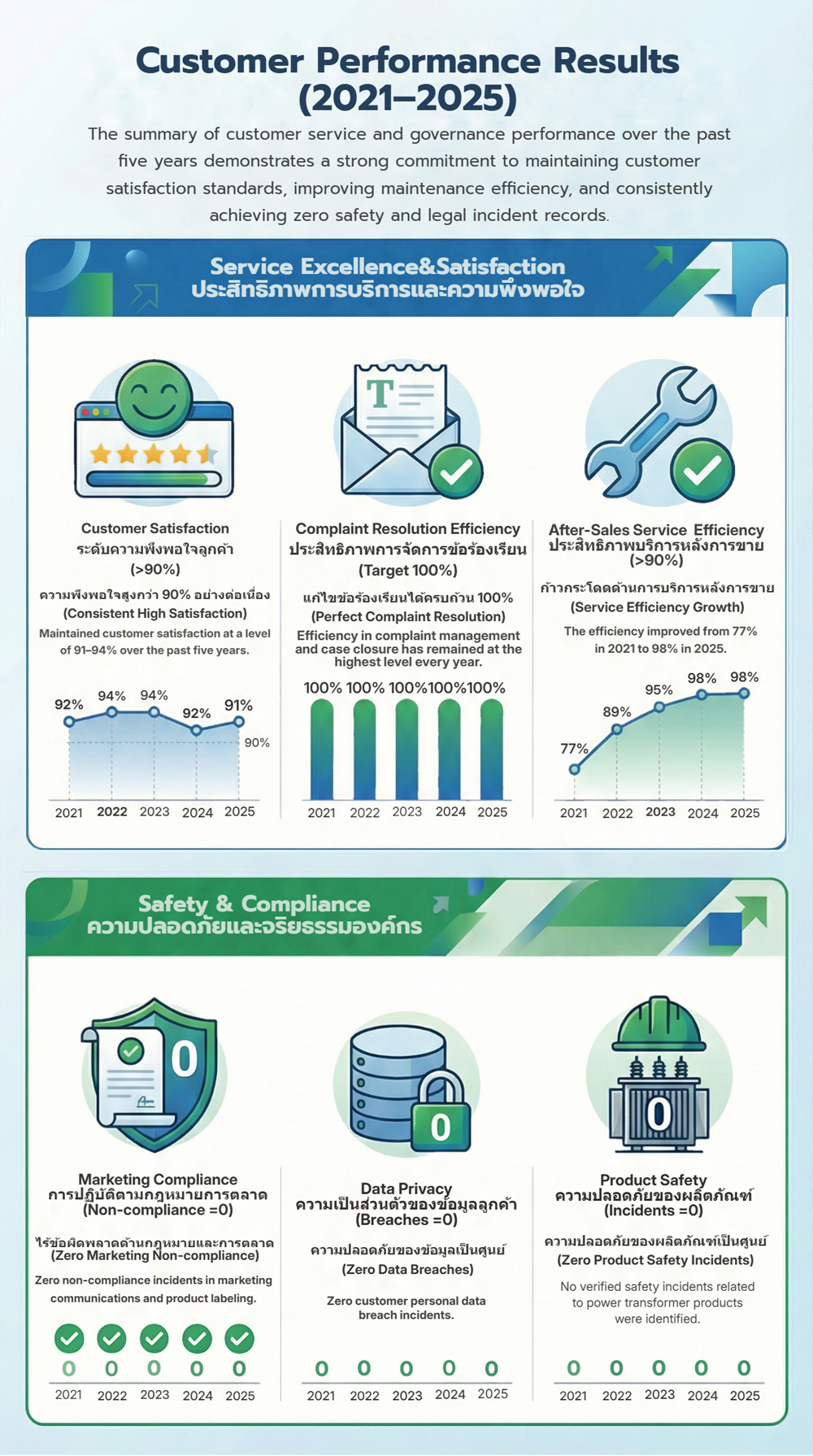
| Customer Satisfaction Score. (To enhance customer satisfaction and strengthen long-term relationships with customers.) | 3009 · Description: Development of customer satisfaction and customer relationship | 2,021 | Customer Satisfaction Score = 92% | 2,028 | Customer Satisfaction Score >90 % |
| Effectiveness in Managing Customer Complaints Related to Products and Services | 3007 · Description: Responsible production and services for customers | 2,021 | 100% of customer complaints were fully resolved and closed. | 2,028 | 100% of customer complaints must be fully resolved and closed. |
| Efficiency of Power Transformer Inspection and Maintenance Services During Warranty Period. | 3007 · Description: Responsible production and services for customers | 2,021 | The efficiency of power transformer inspection and maintenance during the warranty period was 77%. | 2,028 | Efficiency of Power Transformer Inspection and Maintenance Services During the Warranty Period > 90%. |
| Number of Non-Compliance Incidents Related to Marketing Communications, Product Information, and Product Labeling. | 3008 · Description: Communication of product and service impacts to customers/consumers | 2,021 | Zero | 2,028 | The number of non-compliance incidents related to marketing communications, product information, and product labeling must be zero. |
| Number of Customer Privacy Violations and Personal Data Breach Incidents. | 3010 · Description: Consumer data privacy and protection | 2,021 | Zero cases | 2,028 | Number of Customer Privacy Violations and Personal Data Breach Incidents must be zero. |
| Number of Verified Safety Incidents from the Use of Transformer Products and Services. | 3007 · Description: Responsible production and services for customers | 2,021 | Zero Case. | 2,028 | Number of Verified Safety Incidents from the Use of Transformer Products and Services must be zero. |
Customers — Performance & Outcomes
Has Performance Results
Yes
Performance Description
Community & Social — Plan & Guidelines
Has a Community & Social Plan
Yes
Plan Description
Community and Social Management
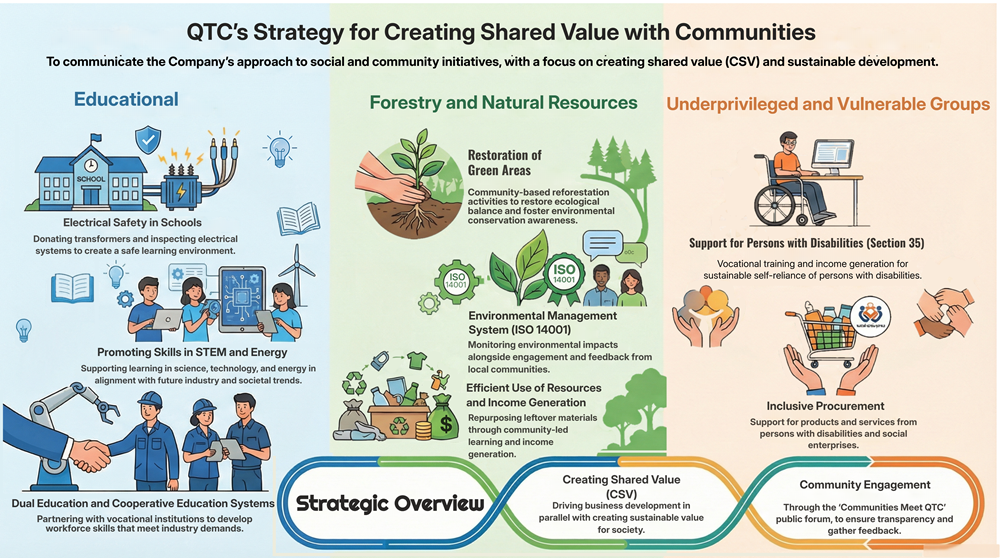
QTC Energy Public Company Limited (“the Company”) conducts its business with due consideration for its responsibilities toward society, local communities, and all stakeholders. The Company adheres to the principles of sustainable development alongside business growth and focuses on creating shared value (Creating Shared Value) with communities in areas where the Company and its subsidiaries operate, under internationally recognized frameworks such as ISO 26000, the Sustainable Development Policy, and ESG principles.
The Company places importance on community engagement through the activity “Community Dialogue: Community Meets QTC”, which provides opportunities for community members, representatives of local authorities, and stakeholders to exchange opinions, acknowledge the Company’s performance, and offer recommendations on issues related to the impacts of business operations. Such input is utilized to appropriately and transparently improve and enhance the Company’s operations.
1. Education
The Company recognizes that education is a fundamental foundation for human resource development and long-term community strength. Accordingly, the Company focuses on promoting access to education, skills development, and the creation of a learning-conducive environment for youth and educational institutions in surrounding areas.
Key initiatives include:
Implementing school development and improvement projects in local communities through employee volunteer activities, such as inspecting and upgrading electrical systems for safety and donating electrical transformers, in order to enhance safety and the quality of teaching and learning in educational institutions.
Supporting learning activities in science, technology, and energy to strengthen skills aligned with future industry trends.
Collaborating with vocational and higher education institutions to promote dual education and cooperative education programs, aimed at developing workforce skills that meet industry needs.
These initiatives contribute to improving the quality of education, expanding equitable access to learning opportunities, and continuously strengthening positive relationships between the Company and local communities.
2. Forests and Natural Resources
The Company places importance on the conservation and restoration of natural resources, recognizing the potential impacts of business operations on the environment and surrounding communities. Accordingly, the Company has established responsible natural resource management practices in alignment with environmental management standards.
Key initiatives include:
Organizing reforestation and green area restoration activities in collaboration with employees and communities to enhance ecosystem balance and foster environmental conservation awareness.
Promoting efficient resource utilization and the reuse of residual materials through projects linked to income generation for local communities.
Implementing environmental management systems in accordance with ISO 14001 standards, along with monitoring environmental impacts in parallel with incorporating feedback from communities.
These efforts help reduce environmental impacts, strengthen mutual understanding with communities, and support the sustainable use of natural resources over the long term.
3. Underprivileged and Vulnerable Groups, Including Persons with Disabilities
The Company respects human rights and social equality, with a focus on enhancing quality of life and creating economic opportunities for underprivileged groups and persons with disabilities, enabling them to achieve sustainable self-reliance.
Key initiatives include:
Implementing projects to promote and enhance the quality of life of persons with disabilities in Thailand in accordance with the Empowerment of Persons with Disabilities Act (Section 35), by supporting vocational training and income generation for persons with disabilities.
Supporting the procurement of goods and services from groups of persons with disabilities and social enterprises to create continuous income and reduce reliance on donations.
Regularly monitoring and evaluating project outcomes through site visits and reporting results to relevant authorities.
These initiatives reflect the Company’s commitment to promoting equality, reducing social disparities, and fostering a society in which everyone can appropriately access economic and social opportunities.
Plan Areas
| Plan Area |
|---|
| Education |
| Forests and natural resources |
| Disadvantaged and vulnerable groups |
Community & Social — Targets
Has Set Community & Social Targets
Yes
Targets
| Indicator | Target Areas | Base Year | Base Year — Description | Target Year | Target Year — Description |
|---|---|---|---|---|---|
| Community Engagement Evaluation Score | 3045 · Other name: Community Engagement · Description: Others | 2,022 | The level of community satisfaction and engagement with the organization’s operations and activities stands at 96.90%. | 2,028 | Target: >98% |
Community & Social — Performance & Outcomes
Has Performance Results
Yes
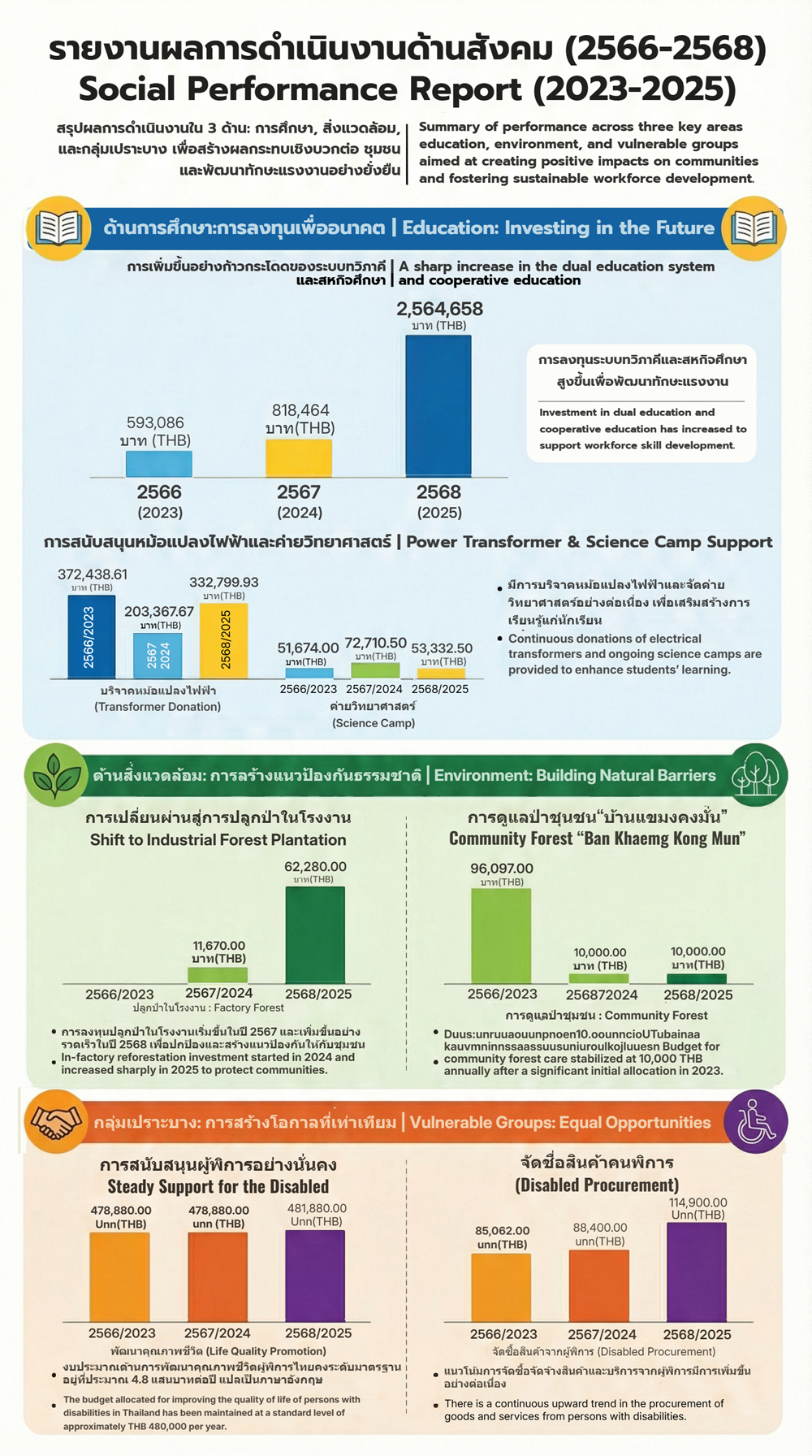
Performance Description
Law Violation Incidents
Law Violation Incidents
| Metric | Current Year | Previous Year | Two Years Ago |
|---|---|---|---|
| The total number of cases or incidents of significant violations of laws or regulations regarding social and human rights (Cases) | 0 | 0 | 0 |
| The total number of cases or incidents that cause significant labor disputes (Cases) | 0 | 0 | 0 |
| The total number of cases or complaints related to consumer rights violations (Cases) | 0 | 0 | 0 |
| The total number of cases or complaints related to partner rights violations (Cases) | 0 | 0 | 0 |
| The total number of cases or incidents that cause disputes with the community/society (Cases) | 0 | 0 | 0 |
| The total number of cases or incidents related to cyber security or customer data breaches (Cases) | 0 | 0 | 0 |
| The total number of cases or incidents related to safety and occupational health at work (Cases) | 0 | 0 | 0 |