

Business Operation · 2025
In this section22 topics
- Corporate Information4 items
- Dividend Policy2 items
- Major Shareholders1 item
- Business Strategies Overview6 items
- Material Changes & Developments1 item
- Use of Proceeds from Securities Offerings1 item
- Commitments Made in the Registration Statement1 item
- Group Operating-Structure Policy1 item
- Companies Where the Company Holds ≥10%1 item
- Shareholders with Potential Conflict of Interest1 item
- Relationships Among Major Shareholders1 item
- Shareholders' Agreement1 item
- Shareholding Diagram (Group Structure)3 items
- Income Structure3 items
- Product / Service Characteristics2 items
- Research & Development6 items
- Assets Used in the Business6 items
- Marketing Policy & Competition3 items
- Procurement of Products & Services8 items
- Projects Under Construction1 item
- Debentures & Bills of Exchange1 item
- Convertible Securities1 item
Corporate Information
Company Name
QTC ENERGY PUBLIC COMPANY LIMITED
Telephone
0-2379-3089-92
Website
www.qtc-energy.com
ir@qtc-energy.com
Dividend Policy
Dividend Policy
The Company has the policy to pay dividends of no less than 50% of the net profit according to separate financial statements after the deduction of corporate income taxes and the allocation of legal reserve each year. However, the Company may consider paying dividends which are different from the specified policy, depending on its operating results, financial liquidity, economic situations, and necessity to use working capital for the Company’s business management and business expansion.
The subsidiary has the policy to pay dividends of no less than 90% of net profit after tax and legal reserve. The Board of Directors will consider the dividend payment by mainly taking into account the benefits for shareholders, such as saving money for future investments or repayment of loans or using it as working capital within the Company or considering the investment plans for business expansion of the Company.
Historical Dividend Payments
| This Year | Last Year | 2 Years Ago | 3 Years Ago | 4 Years Ago | Metric | Description |
|---|---|---|---|---|---|---|
| 107,686,196.84 | 99,252,127 | 48,037,316 | 97,609,220 | 94,246,615 | Net profit per share (Baht : Share) | Net profit per share (baht : share) |
| 0.2 | 0.25 | 0.2 | 0.2 | 0.2 | Dividend per share (Baht : Share) | Dividend per share (baht : share) |
| 0 | 0 | 0 | 0 | 0 | Dividend stock ratio (Number of original shares: dividend shares) | Ratio of stock dividend payment (existing share : stock dividend) |
| 0 | 0 | 0 | 0 | 0 | Dividend share value per share (Baht : Share) | Value of stock dividend per share (baht : share) |
| 68,218,511.4 | 85,273,139.25 | 68,218,511.4 | 68,218,511.4 | 68,218,511.4 | Total dividend payment value (Baht : Share) | Total dividend payment (baht : share) |
| 63.35 | 85.92 | 49.78 | 69.89 | 72.38 | Dividend payout ratio to net profit (%) | Dividend payout ratio compared to net profit (%) |
Business Strategies Overview
Chairman's Message
In 2025, the Thai economy continued to face volatility driven by multiple factors, including geopolitical uncertainties, elevated energy prices, rapid technological transformation, evolving trade policies, exchange rate fluctuations, inflationary pressures, and modest economic growth of approximately 2.2%. Although conditions improved slightly in the final quarter, supported by gradual expansion in consumption, private investment, and accelerated public spending, overall growth remained subdued.
Looking ahead to 2026, the Thai economy is expected to remain in a period of stabilization amid both external and domestic pressures, with projected growth of approximately 2.5–3%. While political stability appears to be improving and the tourism sector is showing positive signs of recovery, the global security landscape continues to present downside risks that warrant close monitoring and prudent management.
In response to these challenges, the Company has formulated strategic initiatives aimed at strengthening operational efficiency and continuously enhancing the expertise and capabilities of our personnel to maintain competitiveness in the global marketplace. We firmly believe that the strength of our people is the cornerstone of sustainable organizational advancement. The Company remains committed to conducting business in accordance with the principles of good corporate governance, transparency, and comprehensive risk management, thereby reinforcing stability and delivering sustainable growth.
In 2026, the Company will strategically expand into emerging clean energy markets to enhance long-term competitiveness. At the same time, we will continue to develop and strengthen our core businesses, particularly amorphous transformers, which improve energy efficiency and reduce power loss, aligning with the global transition toward sustainable and environmentally friendly energy solutions. In addition, we will further advance our integrated solar solutions under a One Stop Service model, electric vehicle charging station business for transportation fleets, battery solutions, and energy storage management systems—industries that demonstrate strong growth potential. These initiatives will be pursued alongside continuous talent development and operations guided by ESG principles.
The Board of Directors places great importance on good corporate governance. In 2025, the company achieved an excellent corporate governance rating for the 11th consecutive year, reflecting its commitment and concrete actions in this area. The company aims to maintain high standards and quality in corporate governance with continuous dedication and rigor.
The Company’s Board of Directors would like to express gratitude to all patrons, stakeholders, and related persons in Thailand and other countries for your consecutive support. The Company would like to ask you to believe that the Company’s Board of Directors would manage our Company to grow stably and sustainably.
Vision
"The commitment to being a leader in innovation and sustainable energy through advanced technology."
Objectives
Moving Forward with Determination and Vision
Quality of DETAILS
DETAILS are the most important key of our operations and they are in every part of QTC from personnel, thinking methods, working methods, technologies, factories, products, including society and environment.
Goals
Policy and Long-Term Goals of Business Operation
The Company has the policy and goal to be a world-class manufacturer of high-quality transformers by focusing on the development of the quality and standards of the Company's transformers to produce transformers with high efficiency and build confidence and recognition from domestic and international customers. The Company sets the goal of generating revenues of 2,000 million Baht by 2028. To achieve such goal, the Company focuses on maintaining the existing customer base and expand the new customer base, especially in the ASEAN countries.
The Company has improved the production processes to be more efficient in order to support market expansion and competition and also increased international sales team to penetrate new markets. Regarding the research and development, the Company unceasingly discovers and develops new products to meet customers’ needs. Currently, the Company develops and produces Smart Transformer, which is the innovation of transformers, and Super Low Loss Transformer that saves energy and reduces global warming in order to meet the needs of all groups of customers. As a result, the Company has strong potential for market competition.
The Company realizes the stability and sustainability of the organization so it expands the business to the energy business and seeks for domestic and international business opportunities in order to build a strong foundation. This includes investments in alternative power plants, along with continued business expansion into 2026, Currently, there are many projects that the Company is studying feasibility. In addition, the Company also expanded its business to be the distributor of energy-related products, such as solar panels and inverters, and other products that the Company is looking for future growth opportunities.
Since the Company emphasizes on valuable human resources, we invest in human resources with emphasis on development under Human Capital Guidelines for developing personnel to connect with organizational strategies in order to obtain competitive competency in world market. The company always adjusts its organizational structure and strategies to keep up with the current situations, for example, adjusted sales process and production process for cost reduction, improved debt collection process to be consistent with current economic condition, situations or crises. With promptness of personnel and technology, the Company gained competitive advantages and built the ultimate satisfaction for our customers on organizational management in order to achieve our goals as mentioned above. The Company attached to the principle of business operation under the concept of “Quality of Details” as well as the principles of Good Governance and Business Ethics for sustainable growth.
Business Strategies
Tendency of Energy Business and Competitive Condition of Transformer and Solar Businesses
Global Energy Industry Trends
The global energy industry is undergoing rapid transformation, particularly in renewable energy sectors such as solar and wind power, which continue to experience sustained growth. This expansion is driven by the increasing global demand for clean energy, along with government support and the declining cost of production, both of which are key factors propelling this growth.
Renewable Energy: The use of renewable energy is experiencing rapid global growth due to the increasing demand for clean energy and efforts to reduce greenhouse gas emissions. Key factors driving this expansion include government support and the declining cost of production.
Emerging Technologies: The development of new technologies, such as green hydrogen and advanced battery storage, is enhancing efficiency and sustainability in energy production and storage.
Green Finance: Investment in renewable energy is being supported by green finance, which facilitates funding for clean energy projects.
Global Warming Crisis
The global warming crisis is a critical issue that affects all sectors of society, including the energy industry. Climate change has led to an increase in extreme weather events, such as heatwaves, floods, and more intense storms. These challenges impact energy production and supply while also driving up operational costs for businesses.
Response to the Global Warming Crisis
Reducing Greenhouse Gas Emissions: The energy sector must focus on reducing greenhouse gas emissions by utilizing renewable energy and high-efficiency technologies.
Adaptation to Climate Change: Energy businesses must develop strategies to adapt to climate change, such as building resilient infrastructure to withstand extreme weather conditions.
Government Support: Government support in the form of policies and green finance is crucial in helping energy businesses adapt and grow during the global warming crisis.
For Thailand, the government has announced the goal of Net Zero Emission by 2065. This will result in the adjustment of the Thai energy business to this change. In addition, investment in renewable energy and the development of clean energy technology will increase. Moreover, Thailand has the opportunity to be a center for production and export of clean energy to countries in Southeast Asia.
In summary, the long-term trend of the global energy business will be to focus more on clean energy, which will result in a major change in the global energy business, and Thailand will need to adapt for this change.
Tendency of Domestic Energy Business and COP27
COP27 was held from 6-18 November 2022 in Sharm El Sheikh, Egypt. Significant progress has been made in tackling climate change, with countries committing to reducing greenhouse gas emissions and mitigating the impacts of climate change.
In Thailand, the government has announced the goal of Net Zero Emission by 2065, which will cause the Thai energy business to adapt for this change. The long-term trend of the energy business in Thailand will focus more on clean energy. We can expect an increase in investments in renewable energy such as solar energy, wind energy, hydro energy, bioenergy and waste-to-energy. In addition, clean energy technology will continue to develop, reducing the cost of producing clean energy and making clean energy more competitive. This will cause a big change in the Thai energy business and we will see a decline in fossil fuels such as oil, coal and natural gas.
According to a report from the Energy Policy and Planning Office (EPPO), it was found that the energy business trends in Thailand will change as follows.
The demand for electrical energy will continue to increase. In2030, the demand for electrical energy will be 69,000 megawatts and in 2065 it will be 120,000 megawatts.
Renewable energy will play an increasingly important role. In 2030, the proportion of renewable energy used in electricity generation will be 30% and in 2065 it will be 70%.
Fossil fuels will play a decreasing role. In 2030, the proportion of fossil fuel used in electricity production will be 70% and in 2065 it will be 30%.
This change will give the Thai energy business an opportunity to expand in the clean energy industry, such as generating electricity from solar power, wind power, hydro power, bioenergy and energy from waste.
Tendency of Domestic Electrical Transformer Business
Although domestic economy has been gradually recovered since the mid of 2022 upon the world’s economy, time spending was still required for adjusting to New Normal. Since electric power consumption was not increased immediately, transformer business tended to be the same throughout the year. However, at the end of the year, government sector had some policies and measures to achieve the goals on Carbon Neutrality and Net Zero GHG Emission therefore many projects were established, for example, Electric Vehicles Support Project by reducing excise tax and import tax leading to expansion of charging stations. This would be possibility to use more transformers in the future. Moreover, Project for Purchasing Electricity from Renewable Energy from the end of 2023 – 2029 will make energy business grow consecutively in the next 7 years.
The long-term trend of the transformer business in Thailand will grow in line with the trend of the Thai energy business. The demand for electrical transformers to support the growing demand for electrical energy will increase. According to a report from the Energy Policy and Planning Office (EPPO), it was found that the demand for electrical energy will continue to increase. In 2030, the demand for electrical energy will be 69,000 megawatts and in 2065 it will be 120,000 megawatts.
This increased demand for electrical energy will result in an increased demand for electrical transformers because electrical transformers will be important in distributing and transmitting electrical energy to consumers. In addition, Thailand has a goal of increasing the proportion of renewable energy in electricity production to 70% by 2065, which will result in increased demand for electrical transformers as well. Renewable energy such as solar power, wind power, and hydro power are often generated in locations far from consumption centers, which require transformers to distribute and transmit the power to consumers.
In addition, electrical transformers tend to evolve towards more modern technologies, such as Super Low Loss transformers, which have high efficiency, low losses and are more durable. These trends will result in the continuous growth of the transformer business in Thailand. It is expected that the market value will be 20,000-30,000 million baht within 2030.
Factors supporting the growth of the transformer business in Thailand include:
Growth in demand for electrical energy
Increasing proportion of renewable energy used in electricity production
Development of modern transformer technology
Tendency of Oversea Transformer Business
The global energy growth trend continues to increase. Including the focus on using clean energy such as solar energy and wind energy, the trend of using transformers will grow as well. But with the cost of raw materials and the cost of shipping by ship is still uncertain. and is likely to increase Therefore, it is considered a challenge to send products abroad. This requires accurate and rapid delivery planning in advance.
Also in the past year Australia's trading partner has a large expansion of the mining industry. With the demand for Rare Earth used as a starting material for producing batteries for electric vehicles and Energy Storage from small to large sizes, it can create a large amount of exports and backlog, including the opening of new markets in European countries will be another channel. One way to make the foreign transformer business grow in the next 2–3 years.
Competitive Condition of Domestic Transformer Business
The transformer market can be divided into power transformers and distribution transformers. In the past, total transformer sales of the Company were sales of distribution transformers. There are about 25-30 manufacturers in the distribution transformer market, comprising small manufacturers focusing on price strategy rather than quality, and medium to large manufacturers focusing on products meeting the quality standards. Therefore, each group of manufacturers will have different customer groups. The Company is regarded as a large manufacturer of high-quality transformers that can provide services to both public and private sectors. The Company’s products are certified by TIS 384-2543. The Company is capable of producing transformers in accordance with various international standards, including IEEE, JIS, AS, and special requirements of each industry. In addition, its products also passed the short-circuit withstand test from CESI, Italy, and KEMA, the Netherlands. As a result, the Company’s products have been recognized for its quality from both domestic and international customers and the quality is improved continuously. This is to enhance the competitiveness of the Company to be comparable or superior to other major manufacturers. Other than this group, it will be a small manufacturer mainly focusing on cost-oriented customers regardless of product quality, which is considered to be a different market from the Company’s products.
It is difficult to enter into the business of a new manufacturer and to develop and improve the transformer production process to obtain quality products according to international standards because it requires the high cost of investment in machinery. Importantly, it also relies on knowledge and advanced production technology, including personnel with good skills and expertise in production. Therefore, the competition in the domestic market is to compete with 6-7 manufacturers with high technology and the capability in the production of high-quality transformers. All of them need to develop production technology in order to be able to produce high-quality transformers that are recognized by customers. The Company manages production costs for maximum efficiency with the main objective of increasing competitiveness continuously and sustainably. In addition to the product development, the Company also focuses on building good relationships with all customer groups in order to maintain and continuously expand our customer base. It can be said that we are the organization that pays attention to all steps in detail according to the Company’s slogan “Quality of Details”.
Currently, we are the first and sole manufacturer and distributor of energy-saving transformers “Super Low Loss Transformer G.2” in Thailand. The product has been certified by the Metropolitan Electricity Authority as an innovative transformer that can reduce Loss in metal core (Loss) by more than 80% and its payback period is within the period 3-5 years. It also passed the short-circuit withstand test from CESI, Italy, so customers can be confident in products and services that are superior to conventional transformers. QTC energy-saving transformer: It can be said that QTC is the first leader in energy-saving transformer technology in Thailand. Currently, government agencies such as the Metropolitan Electricity Authority and the Provincial Electricity Authority are also interested in our Super Low Loss transformers, which have energy-saving quality, help reduce carbon dioxide, and we expect that in the near future they will be purchased to save electricity.
Other Information
| Name | Description |
|---|---|
| Mission |
|
| Work Philosophy | QTC is firmly committed to operating its business based on 3 principles as follows:
|
Material Changes & Developments
Material Changes & Developments
| Year | Description |
|---|---|
| 2,025 |
|
| 2,024 |
|
| 2,023 |
|
| 2,022 |
|
| 2,021 |
|
Use of Proceeds from Securities Offerings
Is There Money Raised from a Securities Offering Still to Report On?
No
Commitments Made in the Registration Statement
Are There Commitments or Conditions from an Offering or Listing?
No
Group Operating-Structure Policy
Description
The Company has a policy to operate its business for sustainable growth in order to create the highest returns for all groups of stakeholders. The Company has expanded its business to cover all types of energy. The parent company mainly engages in the business of manufacturing and distributing transformers and related equipment. The subsidiary operates the power plant business to generate stable and sustainable revenues.
The Company has a policy to invest in businesses that will support and benefit the Company’s business operations or businesses in an industry with a growing trend. The Company will mainly consider the rate of return received from the investment. However, the Company will comply with the regulations and notifications of the Capital Market Supervisory Board and the Stock Exchange of Thailand, including related laws. The Company will consider dispatching directors to be a representative to jointly formulate policies and/or assigning a representative to be an executive to join the management. Such consideration will depend on the appropriateness and necessity in each case.
Companies Where the Company Holds ≥10%
Companies (≥10% Holding)
| Company Name | Address | Province | Zip Code | Telephone | Business Type | Security Type | Shares | Paid-up Shares |
|---|---|---|---|---|---|---|---|---|
| QTC Global Power Company Limited | 2/2, Soi Krungthep Kritha 8 (5), Krungthep Kritha Road, Huamark, Bangkapi, | Bangkok | 10240 | 0-2379-3089-92 | To operate businesses in the generation of electricity and other types of energy. | Common shares | 70,000,000 | 70,000,000 |
| QTC RE Company Limited | 2/2, Soi Krungthep Kritha 8 (5), Krungthep Kritha Road, Huamark, Bangkapi | Bangkok | 10240 | 0-2379-3089-92 | To operate businesses relating to solar energy systems, renewable energy solutions, and all other types of energy businesses. | Common shares | 400,000 | 400,000 |
| QTC EV Company Limited | 2/2, Soi Krungthep Kritha 8 (5), Krungthep Kritha Road, Huamark, Bangkapi, | Bangkok | 10240 | 0-2379-3089-92 | To engage in businesses relating to electric vehicle energy systems. | Common shares | 60,000 | 60,000 |
| PPWE Company Limited | 2/2, Soi Krungthep Kritha 8 (5), Krungthep Kritha Road, Huamark, Bangkapi, | Bangkok | 10240 | 0-2379-3089-92 | To engage in businesses relating to energy. | Common shares | 200,000 | 200,000 |
Income Structure
Product / Service Income
| Category | Description | This Year | This Year % | Last Year | Last Year % | 2 Years Ago | 2 Years Ago % |
|---|---|---|---|---|---|---|---|
| Total revenue from operations | Total revenue from operations | 1,617,598 | 100 | 1,542,518 | 100 | 1,360,905 | 100 |
| Revenue from sales of transformers | 1,081,813 | 66.88 | 1,124,393 | 72.89 | 926,108 | 68.05 | |
| Revenue from sales of Inverter PV Panel and EV Charger | 457,194 | 28.26 | 343,144 | 22.25 | 357,247 | 26.25 | |
| Revenue from sales of solar power business | 45,550 | 2.82 | 47,907 | 3.11 | 53,761 | 3.95 | |
| Other | Other | 33,041 | 2.04 | 27,074 | 1.75 | 23,789 | 1.75 |
Export Income
| Category | Description | This Year | This Year % | Last Year | Last Year % | 2 Years Ago | 2 Years Ago % |
|---|---|---|---|---|---|---|---|
| Total revenue | Total revenue from operations | 1,617,598 | 100 | 1,542,518 | 100 | 1,360,905 | 100 |
| Domestic | Domestic | 1,438,622 | 88.94 | 1,348,236 | 87.4 | 1,143,322 | 84.01 |
| International | International | 178,976 | 11.06 | 194,282 | 12.6 | 217,583 | 15.99 |
Other Income
| Operating Other Income | Non-Operating Other Income | Share of Profit |
|---|---|---|
| 1710 · As of year: 33041.0 · Description: Total other income · As of yesteryear: 27074.0 · As of year before yesteryear: 23789.0 · 1711 · As of year: 30942.0 · Description: Other income from operations · As of yesteryear: 25938.0 · As of year before yesteryear: 23195.0 | 1712 · As of year: 2099.0 · Description: Other income not from operations · As of yesteryear: 1136.0 · As of year before yesteryear: 594.0 | 1713 · As of year: 1.0 · Description: Share of profit · As of yesteryear: -1102.0 · As of year before yesteryear: -910.0 |
Product / Service Characteristics
Business Type
3114
Business Groups
| Business Group | Description |
|---|---|
| Transformer | Nature of Product and Service 1. Transformer Transformers produced and distributed by the Company are made to order according to the customer's purchase order, where the customer will define required specification, such as high voltage and low voltage, loss, impedance, Vector Group, and Temperature Rise, etc. to enable the Company to design transformers that meet customer requirements. The transformers produced and distributed by the Company to all domestic customers are products under the "QTC" trademark. For international customers, there will be products under the "QTC" trademark and the customer's trademark. However, the major components of a transformer are as follows: 1. Steel Core acts as a magnetic circuit for the magnetic flux to induce the high and low voltage in windings. The iron core is made of silicon steel which is cut and stacked to be the core. 2. High-voltage Winding serves as the power receiver from the high-voltage transmission line and converts such power energy into magnetic energy to pass the energy to the low-voltage winding. The high-voltage winding is usually made of enameled round copper wires that are wrapped or wound on the low-voltage winding. 3. Low-voltage Winding serves as the power distributor from the transformer to the load or any connected devices. Low-voltage wire is made of insulated copper wire or copper foil with a relatively large cross-sectional area, wound on an insulating sheath to fix it on the iron core. 4. Transformer Tank and Cover are the component that stores transformer oil and transfers the heat from the inside of the transformer to the outside. The Company applies the production techniques for hermetically sealed transformers. The transformer has a corrugated tank with cooling fins attached to each side of the tank, so the heat is quickly transferred to the outside. The fins are folded from a long steel sheet, resulting in less welds. The likelihood of tank leakage is therefore less than the traditional tank using the radiator fin as a heat sink. The upper area of the tank cover is usually the location where the bushing and protectors of the transformer are installed. 5. Bushing is the part to receive or distribute current of the transformer. The input and output wires are connected to the bushing. Inside the bushing, there is a conductor that conducts electricity into the winding. The bushing is insulated to prevent electric leakage to the transformer tank. 6. Transformer Oil is the oil with the property of good electrical insulation and high purity. It is used as electrical insulation inside the transformer and induces the heat from the winding in the transformer to the tank for ventilating to the external air. 7. Tap is the device that changes the turn ratios of the winding, allowing the voltage ratio of the transformer to be changed as required. 8. Other protective devices, such as oil level gauge, thermometer, pressure relief valve, etc., which are used for measurement in the transformer. When there is any abnormality, it will send the signal to control the switchgear to protect the transformer from severe damages. Transformers produced and distributed by the Company can be categorized into 5 types as follows: 1. Distribution Transformer Distribution transformer is the device that converts the high voltage from the distribution system of the Metropolitan Electricity Authority or the Provincial Electricity Authority transmitted through the distribution line, where the voltage level is not more than 36 kV, and lowers the voltage to the level that meets the needs of the power user, such as industrial plants, houses, residences, and high-rise buildings, etc. It can be classified into 2 types as follows: 1.1 Hermetically Sealed Oil Type Distribution Transformer With the power rating of 3,000 kVA, this type of transformer is an oil-insulated transformer to prevent short circuit in the transformer and transfer the heat from the winding in the transformer to the outside of the transformer. The transformer tank is hermetically sealed to prevent air from entering into the transformer and contacting with oil inside it. Therefore, this type of transformer has good property of moisture protection, which cause the transformer oil deterioration easily. It also helps maintain the insulation condition of the transformer oil to last longer, extend its lifespan, and reduce the cost of transformer maintenance as well. Most of this type of transformer is ideal for outdoor installation. 1.2 Open Type with Conservator With the power rating of 5,000 kVA, it is the conventional transformer which is commonly used for a long time. It uses the transformer oil as an insulator and a heat sink, which is similar to the hermetically sealed oil type distribution transformer. However, there is a conservator installed to support the expansion of the transformer oil during the use. There is air inlet and outlet. At the end of the tube, there is a capsule containing silica gel, a substance that helps to absorb moisture from the air before entering into the transformer. The transformer oil of this type of transformer must be regularly inspected every 6-12 months. 2. Power Transformer A power transformer is a transformer used to reduce the electricity voltage transmitted from the power generation source through the transmission line before transmitting the electric current to the distribution line for further transmission to users. The power transformers produced and distributed by the Company have the power rating ranging from 5,000-30,000 kilovolt amperes (kVA) and the maximum voltage of 72 kV. 3. Cast Resin Transformer Dry type cast resin transformers are suitable for indoor installation as it does not use insulating oil. High voltage windings are casted in Epoxy Resin insulator that is resistant to moisture, dust, and the environment. Projects using dry type cast resin transformers are high-rise buildings, residential buildings or condominiums, hospitals or shopping centers with limited areas so they require transformers that can be installed in the buildings. In addition, the Company invested in the availability of products and personnel to provide services to customers and distribute dry type cast resin transformers tested by international standards to ensure customer confidence. 4. Super Low Loss Transformer (Amorphous Metal Distribution Transformer: AMDT) Amorphous transformer is a transformer that uses the material of amorphous to produce the transformer core instead of silicon steel. The advantage of such material change is that it can reduce the No-Load Loss, which is only one-third of the silicon steel core. This will help users of amorphous transformers to save electricity costs. If the number of amorphous power transformers are used to replace the transformers with silicon iron core, it means saving a lot of electricity at the national level. It also indirectly contributes to the reduction of global warming by reducing greenhouse gas emissions caused by the power generation of the power plants. 5. Special Transformer The Company will design and manufacture according to the applications and specifications required by customers, such as Earthing Transformer, Dry-Type Class F&H, Unit Substation, Pad Mounted, etc. 6. Smart Monitoring Box It is a smart accessory designed to monitor the function of transformers with a sensor that tracks important variables, such as the current in the windings, measure the temperature of windings and oil, and detects the unbalance that may adversely affect the transformer. It can be installed with all models of QTC transformers. 2. Services The Company provides a 24-hour service relating to transformers by a team of engineers and technicians with knowledge, expertise, and experiences in order to support the needs and facilitate customers, including customers purchasing QTC transformers and general customers. In the event of QTC transformers, the Company will provide the contact details on the side of every transformer for customers in the case of emergency. The services relating to transformers provided by the Company to customers are as follows:
|
Research & Development
Has R&D Policy (Y/N)
Yes
R&D Cost — Description
The Company always pays attention to the product research and development to obtain good quality of products that meet customer needs and competitiveness. The Company’s research and development in recent years has been able to develop quality products to compete all global markets, including improve more efficient production processes. In 2025, the Company’s total budget was more than 7,500,000 Baht as follows:
1. Solar Rooftop + Battery Installation Project (Phase 4) – Budget of 5,000,000 Baht
2. Bio-Transformer Oil Development Project – Budget of 500,000 Baht
3. Smart Transformer System Improvement Project – Budget of 500,000 Baht
4. Amorphous Transformer Core Production Capacity Development Project – Budget of 1,500,000 Baht
R&D Cost — Label
Research and development (R&D) expenses over the past 3 years (Million Baht)
R&D Cost — This Year
7.5
R&D Cost — Last Year
4.5
R&D Cost — 2 Years Ago
4.8
Assets Used in the Business
Permanent Assets — Description
As of December 31, 2025, the primary business assets under the ownership of QTC Energy Public Company and Subsidiaries after cumulative depreciation and allowance for impairment losses as shown in the financial statements amounted to THB 872.33 million:
Permanent Assets — Appraisal
| Asset | Ownership | Obligation | Appraisal Value | Description |
|---|---|---|---|---|
| Land located at Bangkok Office | Owner | Free of Obligations | 14.09 | Land located at Bangkok Office, Huamark, Bang Kapi, Bangkok, with the total area of 1 Rai |
| Land of Factory | Owner | Free of Obligations | 96.72 | Land of Factory located at Map Yang
Phon Sub-district, Pluak Daeng
District, Rayong Province, with the total
area of 62-1-31.2 Rai |
| Land of Factory | Owned by Subsidiary | Free of Obligations | 54.68 |
Land of Factory located at Bo Thong
Sub-district, Kabinburi District, Prachinburi Province, with the total area of 219-0-20 Rai
|
| Land of Factory | Owned by Subsidiary | Free of Obligations | 58.83 | Land located at Bo Thong
Sub-district, Kabinburi District, Prachinburi Province, with the total area of 161-2-85.9 Rai
In 2023, QTC Global Power Company Limited, a subsidiary company Purchased land area 161-2-85.9 rai, total value 58.83 million baht. |
| Land Improvement | Owner | Free of Obligations | 5.72 | |
| Land Improvement | Owned by Subsidiary | Free of Obligations | 4.83 | |
| Building | Owner | Free of Obligations | 79.78 | Building located at No.149, Moo 2,
Pluak Daeng-Huai Prap Road, Map
Yang Phon Sub-district, Pluak Daeng
District, Rayong Province |
| Building | Owner | Free of Obligations | 36.47 | Building located at No. 2/2, Soi Krungthep Kritha 8 (5), Krungthep Kritha Road, Huamark, Bangkapi, Bangkok |
| Building | Owned by Subsidiary | Free of Obligations | 3.5 | Building located at No. 102, Moo. 5, Bo
Thong Sub-district, Kabinburi District,
Prachinburi Province |
| Factory Machinery and Equipment | Owner | Free of Obligations | 137.4 | |
| Factory Machinery and Equipment | Owned by Subsidiary | Free of Obligations | 136.69 | |
| Office Supplies and Furniture | Owner | Free of Obligations | 11.94 | |
| Office Supplies and Furniture | Owned by Subsidiary | Free of Obligations | 3.84 | |
| Vehicles | Owner | Free of Obligations | 2.35 | |
| Vehicles | Owned by Subsidiary | Free of Obligations | 0.65 | |
| Building under Construction | Owner | Free of Obligations | 135.7 | |
| Machinery and Equipment during Installation | Owner | Free of Obligations | 89.14 |
Intangible Assets — Description
As of December 31, 2025, Intangible assets as shown in the financial statements as follows:
Intangible Assets — Appraisal
| Asset | Type | Appraisal Value | Description |
|---|---|---|---|
| Computer software | Software | 3.38 | |
| Interconnection charge | Concession | 1.35 | Q Solar 1 Co., Ltd. is the indirect subsidiary paid the interconnection charge into the project of the indirect subsidiary company to Provincial Electricity Authority (PEA). The ownership of the interconnection is belonging to the PEA and the indirect subsidiary has the right to use it. |
Has Subsidiaries Investment Policy (Y/N)
Yes
Subsidiaries Investment Policy — Description
Operation Allocation Policy and Investment Policy of Company Group
The Company has a policy to operate its business for sustainable growth in order to create the highest returns for all groups of stakeholders. The Company has expanded its business to cover all types of energy. The parent company mainly engages in the business of manufacturing and distributing transformers and related equipment. The subsidiary operates the power plant business to generate stable and sustainable revenues.
The Company has a policy to invest in businesses that will support and benefit the Company’s business operations or businesses in an industry with a growing trend. The Company will mainly consider the rate of return received from the investment. However, the Company will comply with the regulations and notifications of the Capital Market Supervisory Board and the Stock Exchange of Thailand, including related laws. The Company will consider dispatching directors to be a representative to jointly formulate policies and/or assigning a representative to be an executive to join the management. Such consideration will depend on the appropriateness and necessity in each case.
Marketing Policy & Competition
Reporting Mode
3117
Marketing Policy (Overall)
Domestic Market Shares
In 2024, the overall market landscape experienced changes in company revenue figures, particularly among competitors that introduced multiple new products, leading to increased total revenue across companies. Only three companies (listed on the stock exchange) disclosed revenue specifically from transformer sales, with the market share distribution among manufacturers as follows:
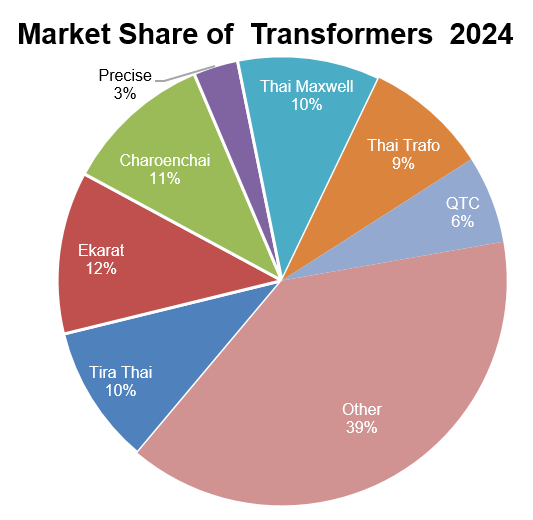
Remark : Charoenchai, Thai Maxwell, Thai Trafo, Fuji Tusco, and SEC report their market share based on total revenue, which includes revenue from other products and services, accounting for 20% - 30% of their total earnings.
Industry & Competition (Overall)
Competitive Strategy
1. Product Quality
The Company has the policy focusing on improving the quality of transformers to meet international standards, starting from the design to the selection of materials used in the production. Regular inspection on the quality of the materials purchased are regularly performed. The Company’s transformers are designed by a complete computerized system, which enhances the capability to control any losses precisely, and engineers with long experiences in specialized design. In addition, the Company applies the state-of-the-art technologies in the production of transformers, which have been well developed and improved. In addition, main machines used in the production are imported from Germany and the product quality is inspected and controlled at every stage of production until the final stage before delivering the products to the customers. All abovementioned operations of the Company aim to ensure that the manufactured products meet the standards and requirements of the customers. It can be seen from the fact that the Company has been certified by ISO 9001: 2015 for its quality and the Company’s all sizes of transformers have been certified for industrial products according to TIS 384-2543, including all electrical systems with the demands available in the market. In addition, the Company’s all sizes of transformers have been tested and certified for shortcircuit withstand from CESI, Italy, and the transformer with 167 KVA is certified by KEMA, the Netherlands, for the short-circuit withstand. Both institutions are world-renowned testing laboratories that can greatly verify the quality and the strength of the windings and the internal structures of the transformers.
2. Rapidness and Reliability of Product Delivery
On-time delivery is another important factor that customers consider when making a purchase order from each manufacturer. Mostly, buyers will determine a clear and definite deadline for goods delivery, especially customers generating and distributing electricity in the state-enterprise sector or customers who are project contractors. If the Company is unable to deliver the products within the specified period, it will affect the customer’s projects to be delayed and the Company may pay penalties depending on the agreement between the Company and each customer. Therefore, it is the main policy of the Company to deliver products on time in order to create customer satisfaction, which will help the Company gain reliability from customers. As a result, customers will continue using the services of the Company or introduce new customers to the Company.
3. Effective Production Cost Management
The Company pays attention to the production cost management, which is the major expenditure affecting its profitability and competitiveness. This includes the selection of materials by an expert team selecting manufacturers and/or suppliers of materials who must pass the inspection of the production process to ensure the quality standards of materials and reduce the loss of production resulting from the use of non-conforming materials. In addition, the Company has implemented an ERP system in planning the purchase of materials, which will help control the quantity of materials to be at the appropriate and sufficient level to meet the demand of the production of the products, because the ERP system will link information from all departments by receiving purchase orders from customers. The system will then process such purchase order information in order to plan the production and the purchase of materials. In addition, the Company has developed production processes and production technology that will help reduce production costs. In the meantime, the Company still maintains the quality of the products very well, for example:
Application of Wound Core Technology for Iron Core Production: Application of such technology will reduce the consumption amount of silicon steel and the loss of silicon steel, resulting in the decrease in lower overall production costs.
Seeking for alternative materials to increase options and effectively manage the Company's cost management, such as using copper foil in replace of paper-wrapped flat wire as a material for winding low-voltage coils, etc.
However, the selection of material will mainly depend on the properties of the transformers as specified by the customer.
4. Provision of Personnel with Experience and Expertise in Transformer Industry
As the Company has a team of executives, engineers, and employees with knowledge, experiences, and expertise for over 51 years in the transformer industry who has been trained by leading international transformer manufacturers in Germany and Japan for a long time, the Company is able to develop design technologies and improve the production process for high efficiency with state-of-the-art machines and reduce the production processes. This will result in the decrease in production costs of the Company and increase its competitiveness with other competitors in the industry very well. Moreover, the Company's sales team has experiences in sales and marketing, so they intensively understand customer needs and transformer market situations and are able to establish different strategies that are suitable for each situation.
5. Cooperation with Business Partners and Creation of Good Relationship with Distributors
In 2025, the Company’s revenue from transformer sales was approximately 18.84% of the revenue from the total sales. It derived from sales through domestic and international distributors. As at December 31, 2024, the Company had 5 domestic distributors and 6 international distributors in 4 countries, namely Malaysia, Australia, Philippines and Italy. Consequently, the Company focuses on maintaining and developing good relationships with distributor continuously, including the cooperation between the Company and distributors to exchange information for using in the development and improvement of the quality of the Company’s products and services unceasingly. As a result, the Company is able to develop products to meet the needs of customers very well.
6. After-Sales Service
The Company’s after-sales service is provided by technicians who have expertise in transformers. They are available to provide consultation and advices on any solutions for customers 24 hours a day. Such service does not only give customers an impression, but also makes the Company aware of problems and defects caused by the products directly from the customer. In addition, such defects can be applied to improve and develop the Company's products to have quality and fully meet the needs of customers. Since the Company's transformer products are of high quality, they are the testament to the reliability of the products with 2 years quality guarantee.
Type of Customer
The Company’s customers can be categorized into 2 main groups as follows:
1. Domestic Customer
The Company’s domestic customer can be classified into 4 types as follows:
1.1 Government and state-enterprise customer
The government and state-enterprise customer group consists of main customers who are state-enterprise electricity generators and distributors, such as the Provincial Electricity Authority (PEA), the Metropolitan Electricity Authority (MEA), the Electricity Generating Authority of Thailand (EGAT), and other government and state-enterprise customers, such as the Ministry of Public Health, Department of Public Works and Town and Country Planning, the Royal Irrigation Department, etc.
1.2 Project contractor
This group of customers is a project contractor ranging from small contractors to large contractors. This type of customer includes Power Line Engineering (Public) Company Limited, Italian Thai Development (Public) Company Limited, Demco (Public) Company Limited, etc.
1.3 Distributor
The distributor will purchase the Company's products to resell to customers (End User). The Company has 6 domestic distributors. Each distributor is responsible for selling transformers and providing services in the specified area, which will help the Company perform the marketing and provide services thoroughly that cover more areas.
1.4 Project owner or industrial plant
This type of customer will purchase the Company's transformers for using in plants or buildings, such as Advance Paper Mill Company Limited, True Universal Convergence Company Limited, and Betagro (Public) Company Limited, etc.
2. International Customer
2.1 Distributor
Currently, the Company has 6 international distributors covering sales of transformers in more than 30 countries. Most of the Company's export revenue derived from the sales through distributors.
2.2 Other customers
Other customer groups include project contractors, trading firms purchasing transformers from the Company for reselling to customers (End User) in any industries, such as customers in the paper industry, petrochemical industry, palm oil industry, textile industry electronics industry, etc.
Pricing Policy
The Company has the policy to determine the appropriate selling price based on the Cost Plus Margin which varies according to the type of customer. The competitive situation of each domestic and international market is taken into account. Regarding the acceptance of the Company’s products of each customer group, it will be determined by the quality of the product and the efficient after-sales services.
Sales and Distribution Channels
Details of the distribution channels of the Company can be divided as follows:
1. Sales by means of Auction
The project auction by means of bidding is the main distribution channel for customers who are state-enterprise electricity generators and distributors. The bidding process starts from the purchase of bidding form. Afterwards, the Company will study and analyze the details of the transformers in order to prepare documents and calculate the price offered in the submission of bidding envelope. Documents used for submitting the bidding envelope are divided into 2 parts, which are the document specifying the qualifications of the bidder and the technical document. The Company is only eligible to participate in the bid after passing the preliminary qualification. To submit a bidding envelope, the Company must deposit a Bid Bond which its value is generally around 5-10% of the value of the bid project. When the Company wins the auction, a sales and purchase contract must be made in the specified form and period. The performance bond shall be deposited, which its value is generally 10% of the value of the bid project.
2. Sales through Distributors
To appoint domestic and international distributors, the Company considers the business expertise, market potential, local experiences, financial position, and readiness of distributors. The written agreement of distributor shall be made. Distributor is responsible for performing the marketing for the distribution of the Company's transformers in clearly designated sales areas and providing services and solutions to customers purchasing the Company's transformers.
As at December 31, 2025, the Company had 5 domestic distributors and 6 international distributors covering sales areas in more than 30 countries.
3. Direct Sales to Customers
The Company's marketing officers and / or sales officers will contact the customer directly. This distribution channel relies on the relationship of executives to build the distribution channel continuously in order to present and provide information about the products to the customers and allow customers to visit the Company's factories. Customers in this channel include project contractors, project architect, or customers who are direct end users, such as industrial plants, etc.
Procurement of Products & Services
Reporting Mode
3117
Procurement (Overall)
Details are provided under the section “Acquisition of raw materials or provision of service.”
Raw Material Acquisition (Overall)
Procurement of Materials
The main materials used in the manufacturing of the Company’s transformers are silicon steel, enameled round wires, transformer tank unit, copper foil, and transformer oil. The Company purchases such materials from both domestic and international manufacturers and/or suppliers. Accordingly, the Company has the policy to purchase materials by considering the following factors.
1. Quality of materials
Since the Company’s main policy emphasizes on the product quality, the Company focuses on the procurement of quality materials from potential manufacturers or suppliers that can fully and punctually deliver quality materials according to specifications. Accordingly, the Company prepares an approved vendor list for screening qualified manufacturers and suppliers. Moreover, the Company has the process to test the quality of materials and visits and inspects factories of new manufacturers before approving them to be the manufacturers or suppliers of the Company. The Company also reviews the evaluation results every 6 months based on the quality and the record of material deliveries. Additionally, the Quality Assurance Unit (QA) conducts a random inspection of materials every time a vendor delivers materials in order to ensure the quality of materials used in the production process of the Company.
2. Material Delivery Period
The delivery period for domestic purchases of materials is generally 15-30 days, depending on the type of materials. Meanwhile, in purchasing raw materials from abroad, the company has to spare for transportation time, as the crisis of container shortages and the decline in the number of shipping vessels have affected the delivery time of raw materials by 15-30 days, depending on the country of purchase. Therefore, in most cases, if it is general material or domestic manufacturers or suppliers can supply materials with similar quality to those offered by international manufacturers or suppliers or meet the quality requirements of the Company, e.g., enameled round wires, paper-wrapped flat wire, enameled flat wires, and other transformer accessories, the Company will purchase such materials from domestic sources because the delivery period and it is more convenient and efficient to manage the inventory.
3. Price of Material and Trend of Material Price
In 2025, the prices of key raw materials, such as silicon steel and transformer oil, are expected to decline, while copper prices are projected to rise. However, the main raw materials such as silicon steel, copper as well as hot-rolled and cold-rolled steel used for body fabrication are commodities with prices that fluctuate based on prices in the global market. Therefore, regarding each lot of material purchase, the Company will consider the quantity of materials to be purchased and suitable delivery period. The Company closely monitors changes and trends of material prices to effectively manage its costs.
4. Exchange Rate
As the Company purchases 13.83% of all materials from foreign countries, the Company closely monitors changes in the exchange rates of important financial currencies and appropriately enters into a FX forward contract to hedge any risks from foreign exchange rate fluctuation.
5. Avoidance of Dependency on Single or Few Manufacturer or Supplier
The Company has the policy to procure materials from several manufacturers or suppliers. For each type of materials, especially silicon steel, enameled round wires, copper foil, and transformer oil, the Company purchases them from only 2-3 main manufacturers or suppliers because each manufacturer and supplier has specified minimum purchase orders based on prices and delivery period of the material.
Table of Proportion of Domestic and International Material Purchases
Year 2023 | Year 2024 | Year 2024 | ||||
Million Baht | Percentage | Million Baht | Percentage | Million Baht | Percentage | |
Domestic Material Purchases | 410.54 | 77.75 | 584.87 | 70.83 | 1,428.30 | 86.17 |
International Material Purchases | 117.51 | 22.25 | 240.91 | 29.17 | 229.23 | 13.83 |
Total Material Purchases | 528.05 | 100 | 825.78 | 100 | 1,657.52 | 100 |
The Company’s main materials are detailed as follows:
1. Silicon Steel
Silicon steel is an important material of transformers, accounting for 13.83% and 13.26% of the total material purchase value in 2024 and 2025, respectively. The Company mainly imports silicon steel from the Republic of South Korea and some is from Japan and China. These materials are ordered and purchased in advance on a quarterly basis. However, since there is a few manufacturers of high-quality silicon steel used for manufacturing transformers, the quantity of silicon steel manufactured is limited. Therefore, the Company has to manage the procurement sufficiently to meet the needs of usage and successfully manufacture transformers for customers on schedule.
2. Enameled Round Wires
Enameled round wires are materials used for winding high-voltage coils or high-voltage wires. Its function is to receive electrical energy from high-voltage transmission lines and convert it into magnetic energy circulating inside a steel core in order to transfer energy to the low-voltage coils. Such materials are purchased from domestic manufacturers that offer quality similar to or equivalent to materials imported from foreign countries but take a shorter delivery period. As a result, the Company can manage inventories more effectively.
3. Transformer Tank Unit
By 2025, the company's new body manufacturing plant continues to be in full capacity and added laser cutting machine cutter for replacing plasma steel cutter machine could cut steel with more thickness. It improves steel cutting edge quality, reduces grinding process, removes cutting blur. Jig Fixture and Robot are installed for body assembly before welding, replacing the use of staff, helping to control the same size of every assembled tank, allowing continuous welding by Robot, without interruption from programming. In addition, automatic body paint coating machines are being installed to control the coating evenness quality and also to reduce the time spent on the worker's chemical exposure, which is a dangerous job. It is expected to be available by the first quarter of 2022. The addition of such automated machines allows for continuity of body production, eliminating unnecessary steps, reducing wait times, enabling faster body production, increasing body production capacity, reducing ordering the transformer body from outside, reducing production costs, and meeting the need for transformers with short delivery times, and enabling quality control according to customers’ requirements, resulting in increased competitiveness. However, there are also orders from a few domestic manufacturers depending on the nature and quantity of work, price and delivery time.
4. Transformer Oil
Transformer oil is specially produced for use in transformers and has good insulation properties. Its function is to remove heat from the inside of the transformer to the outside for ventilation. Regarding the purchase of transformer oil, the production plans are taken into account. The purchases are made at least 3 months in advance from domestic manufacturers and suppliers in order to prevent shortages of materials. The Procurement Department regularly monitors changes of oil prices in the global market to effectively manage the purchase of transformer oil.
5. Copper Foil
Copper foil is the raw material used for winding low-voltage coils or low-voltage wires. Its function is to distribute electricity from the transformer to load or connected devices. The Company purchases copper foil from both domestic and international manufacturers. With the joint development of capable domestic manufacturers, the Company is able to purchase such material from domestic manufacturers that meet international standards which helps the Company effectively manage material with appropriate quantity.
Production Policy (Overall)
Production Sector
1. Production
The Company's factory is located at No. 149 Moo 2, Pluak Daeng-Huai Prap Road, Map Yang Phon Sub-district, Pluak Daeng District, Rayong Province, on an area of 32 Rai. Most of the transformers are made to order based on customers’ requirements. The Company has the policy to manufacture transformers to meet customers’ requirements by mainly focusing on quality and standards. State-of-the-art design and manufacturing technologies are applied, including main machines used in production, such as steel slitting machine, steel cutting machine, coil winding machine, heating oven, etc. These machines are imported from Germany and leading countries. Transformer testing process is in accordance with international standards and is controlled by a computer system to increase competitiveness and support the expansion of the business in the future.
In 2025, the Company is still committed to applying the TQM system to improve production processes and production planning continuously. The main goal is to reduce the production period in order to increase production volumes and adjust production processes to create a line balance and reduce losses, such as waiting time, and overproduction, etc. However, the Company focuses on the full and efficient use of capacity and begins to use the production order system and the real-time production hour reports to connect to the information from the Company's ERP system and use such information to manage and monitor operations in the production process. In addition, it can submit information, such as production volume, working time, to the ERP system to reduce errors from reporting, reduce redundancy, and reduce paper usage.
2. Production and Production Process
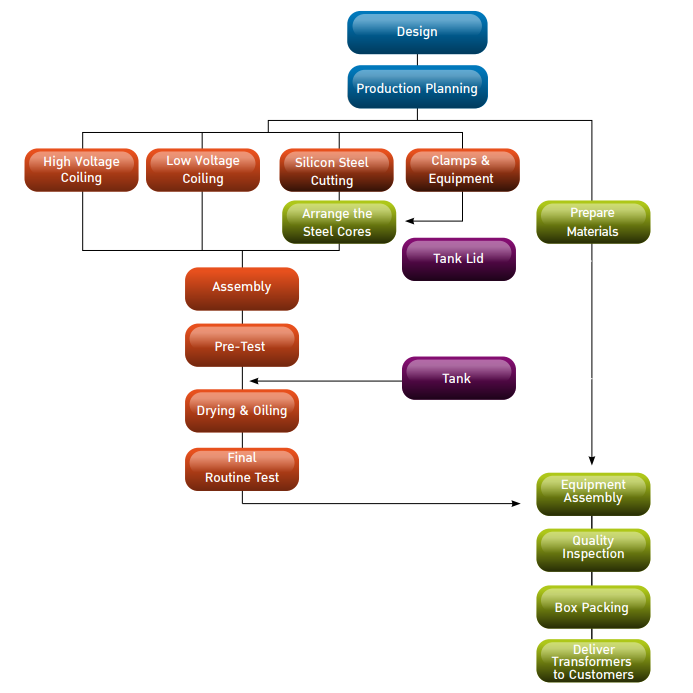
The Company's distribution transformer production process is as follows:
1. Design
The Company’s transformers are made to order based on customers’ purchase orders. The transformers are designed by using a complete and state-of-the-art computer program with high accuracy and qualified and capable engineers with extensive design experience to ensure that the results meet the customers’ specifications and purpose of use. It can be displayed as an outline drawing immediately.
2. Production Planning and Equipment Preparation
The customer’s transformer purchase order information will be entered into the ERP system and used to plan the purchase of materials and equipment, including the production. Regarding the planning, the production plan will be updated so that the products can be manufactured and delivered on time as required by customers. This requires close cooperation among the Sales Department, the Production Department, and the Procurement Department.
3. Silicon Steel Cutting and Steel Core Arrangement
The Company uses a silicon steel cutting machine from Germany which is controlled by a computer system, making it possible to cut steel quickly and precisely. The computer will calculate the drilling locations of the steel core and cut the steel at the same time, so the cut silicon steel core still retains its full electrical properties. The silicon sheet will then be cut to shape and sent to the steel arranging section. For the steel arrangement, the steel pieces will be placed in overlapping levels (Step-Lap) using a stacking table. Such step-lap method results in no-load loss and the reduction of exciting current of the steel cores, which will reduce the transformer’s noise level and costs for the loss values.
4. Low Voltage and High Voltage Coil Winding
The Company uses copper foil as the material used for winding the low-voltage coil instead of using the conventional paper-insulated flat wires. As a result, the transformer provides the maximum resistance to power surges and short circuits because the copper foil has better current distribution properties. In addition, the long layer method is applied to wind the high-voltage coil by using the High Voltage Winding Machine that can control the tension and the coil arrangement with a computer system to make the quality of each coil layer meet uniform tension standard which will increase the effectiveness and quality of the transformer.
5. Assembly of Coils and Steel Cores
This step takes place when the coils are assembled to the steel cores. The low-voltage coil is assembled and attached to the steel core and the high-voltage coil is placed on top of the outer part of the low-voltage coil. Afterwards, the upper yoke is assembled and the tank cover, bushing, and tap changer are installed, and the internal wiring is then connected according to the designed drawing.
6. Pre-Test
Once the steel core and the low-voltage and high-voltage coils are assembled in the tank, the Testing Department will then perform the pre-test of transformers as follows:
Measurement of Winding Resistance
Measurement of Turn Ratio
Inspection of Polarity or Vector Group
Megger Test
7. Drying and Oil Filling
For the drying to remove moisture from transformers, the Company uses a modern vacuum oven controlled by a computer system from Germany. Furthermore, the Company is the only company in Southeast Asia that uses Electric Low Frequency Heating technology to remove moisture from the transformer by directly delivering low-frequency currents to the coils of the transformer under the vacuum condition, which is a way to transmit heat from the inside to the outside. This method will remove moisture from the innermost part of the coils in a short time compared to the heater which is a method used to heat the coils from the outside to the inside, but it is unable to remove moisture from the innermost part. In addition, the Company also applies technology to fill the transformer oil in a vacuum oven, allowing the oil to efficiently infiltrate the insulation system. It can prevent 100% of moisture from coming in to contact with the oil inside the transformer, which effectively extends the transformer’s lifespan.
8. Routine Test
After going through all procedures, all transformers will be required to go through the routine test. The Company’s testing equipment is controlled by the computer system and calibrated regularly for precision. As a result, the test results are accurate and precise and can be reported immediately. The testing list consists of:
Measurement of winding resistance
Measurement of voltage ratio and check of phase displacement
Measurement of short circuit impedance and load loss
Measurement of no-load loss and current
Separate source AC withstand voltage test
Short-duration induced AC withstand voltage test
Measurement of insulation resistance
Oil dielectric test
Leakage test
Distributors (Overall)
N/A
Number of Raw-Material Distributors (Overall)
0
Production Capacity (Overall)
| Item | Unit | Unit (if Other) | Used | Capacity |
|---|---|---|---|---|
| Capacity of Plants | Others | kVA | 71.85 | 2,880,000 |
Domestic/Overseas Purchase Proportion (Overall)
| Raw Material | Source Country | Value |
|---|---|---|
| N/A | South Korea | 0 |
Projects Under Construction
Has Projects Under Construction (Y/N)
No
Debentures & Bills of Exchange
Has Debentures (Y/N)
No
Convertible Securities
Has Convertible Securities (Y/N)
No